lgbtq
The letters LGBTQ are just another way of saying that Love is Love.
(4) Unequal Enforcement
- The Requirement of Unilateral Law - Law only functions as law when it is applied unilaterally. This does not mean identically or blindly, but reciprocally and predictably. A unilateral legal system is one in which rules bind all parties regardless of status, wealth, or position, and where increased power brings increased exposure rather than exemption. When this condition holds, law operates as a shared boundary that constrains behavior and stabilizes cooperation. People may disagree with outcomes, but they can anticipate them. That predictability is what allows trust to exist even in imperfect systems.
By Peter Thwing - Host of the FST Podcastabout a month ago in Humans
(3) Authority Without Consequence
- The Moment Authority Became Untethered - Every functioning system of governance relies on a constraint so fundamental it often goes unnoticed until it disappears: authority must be exposed to consequence. When those who make decisions experience the downstream effects of those decisions personally, power is naturally disciplined by risk. That discipline does not require virtue or foresight. It operates mechanically. Decisions that produce harm are abandoned because they injure the decision-maker, and decisions that succeed are reinforced because they reward restraint. Modern political systems did not lose this constraint through a single reform or moral collapse. They lost it gradually, through delegation, bureaucratic layering, procedural complexity, and the normalization of distance between action and outcome, until authority could be exercised without meaningful exposure to its effects.
By Peter Thwing - Host of the FST Podcastabout a month ago in Humans
(2) From Stake to Abstraction
- The Original Logic of Representation - For most of human political history, representation was not conceived as a mechanism for expressing individual preference or personal identity. It was understood as an extension of responsibility. Political participation flowed to those who bore the material risks of maintaining the community, because those risks imposed discipline on decision making. To have a voice in governance meant being exposed to the consequences of governance. That exposure included taxation, compulsory service, property seizure, legal punishment, and, in many cases, the obligation to physically defend the community. Representation was therefore not grounded in abstract equality, but in the practical need to align authority with liability so that decisions would remain tethered to reality rather than sentiment or impulse. The system did not assume wisdom or virtue. It assumed self-interest and constrained it by consequence.
By Peter Thwing - Host of the FST Podcast2 months ago in Humans
(1) Seeing the System Clearly
- The Shared Feeling No One Can Quite Explain - Most people do not need to be convinced that something is wrong. They feel it in rising costs that never seem to stabilize, in rules that change without explanation, in institutions that demand compliance but no longer command trust, and in a political process that feels permanently hostile yet strangely ineffective. These experiences are not isolated. They are widespread, persistent, and remarkably consistent across demographics, ideologies, and personal circumstances. What differs is not the feeling, but the explanation people are given for it.
By Peter Thwing - Host of the FST Podcast2 months ago in Humans
(0) Prologue: Before You Read
This series is written for readers who sense that something in the structure of modern life no longer works the way it once did, but who have found most available explanations unsatisfying. It assumes the reader is capable of sustained attention and willing to engage with complexity without demanding immediate resolution. It does not assume political alignment, ideological agreement, or shared conclusions. What it does assume is a willingness to slow down long enough for clarity to emerge.
By Peter Thwing - Host of the FST Podcast2 months ago in Humans
Dr. Martin Luther King Jr. Day
Introduction Dr. Martin Luther King Jr. Day is a special holiday celebrated in the United States. It honors the life and work of Dr. Martin Luther King Jr., a great leader who fought for freedom, equality, and justice. This day reminds people to treat everyone with respect and kindness, no matter their skin color, religion, or background. Dr. King believed in peace and non-violence, and his message is still important today.
By Farhan Sayed2 months ago in Humans
Coming Out as Trans
Six years ago I had a well meaning therapist try to point out to me that I should take a look within myself and see how I feel about my gender orientation. He said this due to a year of me unloading all of my issues and insecurities onto him and a pattern that he recognized within my stories that I personally did not, and would not for another four years.
By Shiloh Madison2 months ago in Humans
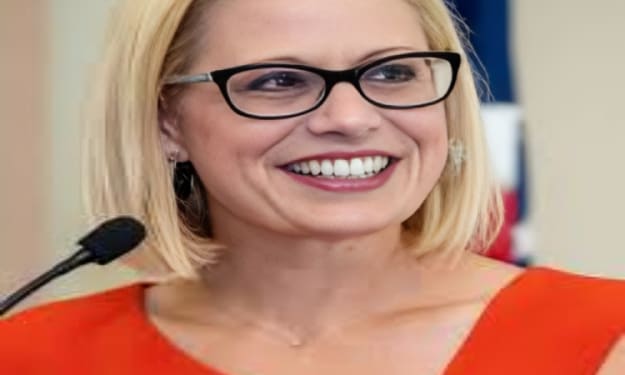
Kyrsten Sinema
Kyrsten Sinema is an important American political leader. She worked for many years in the U.S. government and became known for being different from many others in politics. This article uses easy English and clear subtitles to help you understand who she is, where she came from, what she did, and what is happening now with her.
By Farhan Sayed2 months ago in Humans
Sophie Turner
Introduction Sophie Turner is a famous English actress. She is best known for her role as Sansa Stark in the popular TV series Game of Thrones. Sophie became famous at a young age and grew up in front of the camera. Over the years, she has worked hard to improve her acting skills and build a strong career in film and television. She is admired not only for her talent but also for her honesty about personal struggles and mental health.
By Farhan Sayed2 months ago in Humans
The People Who Sit by the Window
Buildings blurred into one another, storefronts flickered past like unfinished thoughts, and the sunlight slipped through the windows at an angle that made everything feel temporary. Emma always sat by the window. Not because she loved the view, but because it gave her something to focus on when her thoughts became too loud.
By Yasir khan2 months ago in Humans
The Attention Economy Is Quietly Rewriting Our Minds — and Most People Don’t Notice
Every time you unlock your phone, scroll a feed, or tap a notification, you are participating in something far bigger than momentary distraction. You are engaging in what experts call the attention economy — a system where human focus is the most valuable resource on Earth. This isn’t hyperbole. It’s reality. For the companies that fuel the modern internet, your attention is currency. Every second spent watching, clicking, or reacting generates data that platforms use to predict your behavior, tailor your feed, and pull you deeper into their ecosystem. And the consequences go beyond algorithms. They are reshaping how we think, feel, and decide — often without our conscious awareness.
By Yasir khan2 months ago in Humans
The Day My Phone Started Knowing Me Better Than I Did
It started with a notification I almost ignored. “Good morning, Alex. Based on your sleep patterns, we’ve adjusted your morning schedule. Coffee is ready at 7:15. You might want to leave home at 8:03 instead of 8:10.” I froze. My phone had never spoken to me like this before. Sure, it suggested playlists, predicted traffic, and reminded me of appointments. But it had never calculated me this precisely. Curiosity overcame caution. I followed its instructions. The coffee was perfect. Traffic was lighter than usual. I arrived at work feeling oddly efficient.
By Yasir khan2 months ago in Humans