
A Warning About Buying a Home in This Economy
Even though a full housing crash in 2026 is unlikely, that does not mean buying a house is automatically safe or affordable right now.


Buying a home has long been considered one of the most important financial milestones in adulthood. For many people, it represents stability, long-term investment, and the ability to build wealth through property ownership.
However, in the economic environment of 2026, taking on a mortgage without proper preparation can quickly become financially dangerous.
Home prices remain historically high across much of the United States, and mortgage interest rates are significantly higher than they were just a few years ago. While rates hovered around 2–3% during the pandemic housing boom, most 30-year mortgages today sit closer to 6–7%. That difference dramatically increases monthly payments, even if the home price itself hasn’t changed.
Because of this shift, financial experts increasingly warn that buyers should approach homeownership cautiously and make sure they have substantial savings and stable income before committing to a mortgage.
Simply qualifying for a loan through a bank does not necessarily mean a home purchase is financially safe.
Why Savings Matter More Than Ever
Many first-time homebuyers focus almost entirely on the down payment, assuming that once they purchase the home, their financial challenges are mostly over.
In reality, owning a home often comes with a long list of unexpected costs, including:
• repairs and maintenance
• appliance replacement
• rising property taxes
• insurance increases
• HOA fees in some communities
• emergency home repairs such as plumbing or roofing issues
Financial planners generally recommend that homeowners set aside 1–3% of the home’s value each year for maintenance alone.
For example, someone purchasing a $400,000 home may need to plan for $4,000–$12,000 annually in maintenance costs.
Without savings, these expenses often end up on credit cards or personal loans, which can quickly create a cycle of debt.
The 30% Rule for Housing Costs
A commonly used guideline among economists and financial advisors is the 30% rule.
This rule suggests that your total housing costs should not exceed about 25–30% of your gross monthly income.
Housing costs include more than just the mortgage payment. They also include:
• property taxes
• homeowner’s insurance
• mortgage insurance (if applicable)
• HOA fees
• maintenance estimates
When housing costs rise above this range, homeowners often find themselves financially stretched, especially during economic uncertainty.
Safe Income vs Mortgage vs Savings (2026 Guidelines)
The chart below offers a conservative estimate of what many financial experts consider a financially responsible home purchase range.
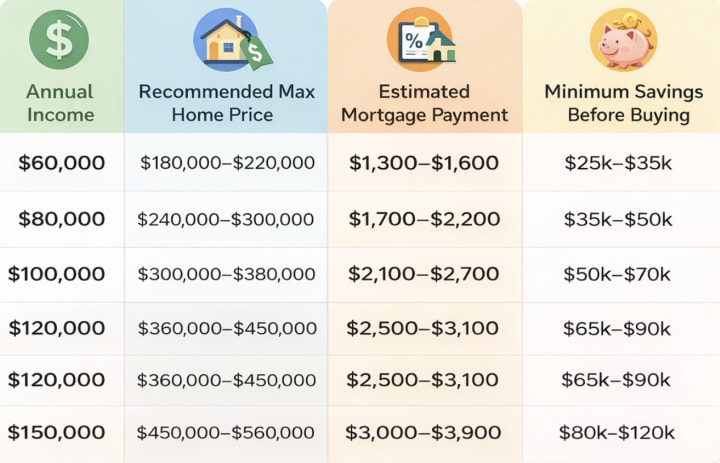
These estimates assume mortgage rates around 6–7%, which is typical in the current market.
The savings column includes several key financial cushions:
• down payment
• closing costs (usually 2–5% of the home price)
• emergency savings
• moving expenses
• initial repair costs
Many first-time buyers underestimate how quickly these expenses add up.
A Major Mistake Many Buyers Make
One of the most common financial mistakes in housing is assuming that the maximum loan approval equals an affordable budget.
Banks often approve mortgages based on debt-to-income ratios that represent the upper limit of borrowing, not necessarily what will feel comfortable month-to-month.
For example, someone earning $100,000 annually might technically qualify for a home far above the recommended price in the chart above.
But that can leave very little room for:
• unexpected expenses
• medical bills
• job loss
• rising interest costs
• general cost-of-living increases
In uncertain economic conditions, financial flexibility can be just as important as homeownership itself.
The Safest Approach to Buying a Home
For buyers considering entering the housing market in 2026, financial experts often recommend a cautious approach.
This includes:
• buying below your maximum budget
• maintaining at least 6–12 months of living expenses in savings
• planning for long-term ownership rather than short-term investment
• accounting for rising taxes and insurance costs
A home should provide stability and security, not constant financial stress.
The safest home purchase is one where the homeowner still has room in their budget to live comfortably, save money, and handle unexpected challenges.
In today’s economy, patience and preparation can make the difference between a home becoming a valuable long-term asset or a source of ongoing financial pressure.
About the Creator
Navigating the World
News, commentary on entertainment, music, influencers, and modern culture, upcoming artists, politics, and more. Everything you need to know — all in one place.
Keep reading
More stories from Navigating the World and writers in Journal and other communities.
Florida Passed a Bill Allowing Suspension of Officials for “Promoting Pride,” Sparking National Debate
A controversial new bill passed by the Florida legislature is drawing national attention after it would allow Governor Ron DeSantis to suspend local elected officials accused of “promoting” Pride-related activities through diversity, equity, and inclusion (DEI) programs.
By Navigating the Worldabout 24 hours ago in Journal
Author’s Advice
If you would’ve asked me 20 years ago did I know I’d become a writer and an author, I would’ve said “nope, ain’t happening”. As fate would have it I did become an author and I can honestly say I’m loving it so far. It really does feel good to be a writer. I’ve learned a lot on this journey and I feel like with even me being as new to this world as I am, there’s some wisdom I need to share with every other aspiring author.
By Joe Patterson3 days ago in Journal
Mastering Operational Excellence
In today’s fast-paced business environment, organizations are constantly searching for ways to stay competitive, maintain quality, and scale efficiently. While strategy, innovation, and market positioning are important, the true differentiator often lies in operational excellence. It’s not a buzzword—it’s a discipline that transforms ordinary organizations into high-performing, resilient enterprises.
By Kenneth Kremsky3 days ago in Journal



Comments
There are no comments for this story
Be the first to respond and start the conversation.