history
Key historic events throughout the ages in relation to business, work, corporate figures and moguls.
The Empty Locker
I didn’t know his name at first. I only knew the silence. It was a Tuesday in October. The high school hallway buzzed with its usual chaos—backpacks slamming, laughter echoing, sneakers squeaking on linoleum. But one locker stayed shut. No one leaned against it. No one dropped off homework. Just a quiet space where a boy should have been.
By KAMRAN AHMADabout 16 hours ago in Journal
The Suitcase in the Hallway
I didn’t pack lightly. The suitcase sat by the door for three days—half-full, then overflowing, then emptied again. I kept adding things I thought I’d need: my favorite coffee mug, the photo from last summer, the sweater that still smelled like home. Then I’d take them out, convinced they were too heavy, too sentimental, too much.
By KAMRAN AHMADabout 16 hours ago in Journal
The Couple We All Watched Grow Up
I didn’t know them. But I felt like I did. For over a decade, they were part of my life—not as celebrities, but as characters in a story I watched unfold in real time. I saw them at seventeen, awkward and bright-eyed on red carpets, fumbling through interviews, hiding smiles behind their hands. I saw them navigate fame, heartbreak, and the slow, steady work of becoming adults—all while the world watched, judged, and claimed ownership of their journey.
By KAMRAN AHMADabout 16 hours ago in Journal
Modern Global Colonialism and the Echoes of the Ancient Provincial System: Is the World Still Under the Influence of a New Empire?. AI-Generated.
Special Investigation Report Malik Sarfaraz Hussain Awan, Journalist, Social Guardian Humanitarian: In the in-depth study of world political history and the changing context of international relations, it is clear as day that the ancient principles of the struggle for supremacy and dominance between states, which were prevalent centuries ago during the era of the Roman, Greek and Mongol empires, are still in force today in a new and modern form. If we turn the pages of ancient history, it is found that there were only two basic methods used to occupy any conquered territory. The first method was to directly make the territory a regular part of one's empire and establish its own provincial structure there and appoint its own governor and administration and take all the powers over to the center. In the other case, if a country accepted submission without military conflict, the local rulers there were maintained in their positions, but with the strict condition that they would be bound to obey every order received from the emperor and their status would be that of a mere puppet or representative. If we look closely at world politics in today's modern era, this second principle is clearly at work, where the global status of the United States has become that of a superpower that controls the majority of countries on the world map through their local rulers for its own political and military purposes. Political analysts believe that many countries in the world are apparently called sovereign and independent states, but the fabric of their foreign and domestic policies is linked to Washington's interests, and their rulers often make decisions that are approved by the chambers of world powers. Under this system, countries that try to achieve their true independence or form an independent economic and defense bloc that conflicts with American interests are tried to be derailed in various ways. History is full of incidents where American intelligence agencies intervened and overthrew popularly elected governments, or forced these countries to their knees through economic sanctions and diplomatic isolation. In Latin America, From the intervention of the CIA to the Middle East and South Asia, there are dozens of such evidences where either direct military invasions were carried out or political change was brought about by using the internal military structures of these same countries in order to install pawns there who remain loyal to the American empire. At present, on the world stage, Russia, Iran, China and North Korea are some of the prominent countries that have refused to accept this global domination and have maintained their own separate identity. The example of Iran is very important in this regard because the Iranian leadership has refused to bow down despite the economic war and all kinds of global pressure that have been going on for the past several decades and has not traded its self-determination. This is why all the attention of the United States and its peers is focused on weakening Iran because it is setting an example of a state that is determined to survive without external dictates. On the other hand, Russia and China have jointly laid the foundation for a multipolar world order that is challenging the unipolar American hegemony, while North Korea has continued to develop its defense capabilities despite all the sanctions. Through self-sufficiency, it has proven that it will not compromise on its security at any cost. If we examine the situation in the Islamic world, it is a bitter truth that under a specific global policy, the Muslim countries of the Middle East have been entangled in a web of mutual wars and contradictions from which it is becoming increasingly difficult to escape. The growing differences between Muslim countries are in fact a continuation of the same divide and rule policy, the aim of which is to paralyze their collective strength. When the United States had to withdraw from Afghanistan after a twenty-year-long war, it indirectly put the security complexities of the region on Pakistan's shoulders in order to reduce its economic and human losses. The kind of security challenges and new wave of terrorism that Pakistan is facing today are a manifestation of this change. Moreover, in order to maintain its influence in the region, the United States has made such defense agreements between Pakistan and Saudi Arabia, the effects of which can be very far-reaching. Foreign affairs experts believe that one of the objectives of these agreements is to If there is a direct conflict between Iran and Saudi Arabia in the future or if American installations on Saudi soil are threatened, Pakistan could be confronted by Iran on the basis of these agreements. This situation is very sensitive for a country with nuclear power like Pakistan because on one side is the brotherly Islamic country of Iran and on the other side are economic constraints and defense promises. Pakistan's economic situation has reached a point where it is completely breathing on loans from the International Monetary Fund (IMF). Economic experts say that if the IMF program is closed, Pakistan's economy is in danger of suffocating, and this is the economic constraint that takes away the true independence of any country when a country becomes economically dependent on another.If it is, its foreign policy decisions are not independent, but rather they become beholden to the lending institutions and the powers behind them. History is witness that economic slavery always proves to be a precursor to political slavery, and in the present era, the debt trap is doing the same thing that weapons of war did in ancient times. Now, world politics stands at a crossroads where on one side is the old model of American imperialism that wants to run the entire world through its states and governors, and on the other side are those countries that yearn to break free from this domination and live with their own pride and self-restraint. This is a very difficult time for the Muslim world because on the one hand there is the dream of Islamic unity, and on the other hand there is the bitter ground realities and the quagmire of mutual conflicts in which they have been sunk. Now it remains to be seen whether the United States will be able to maintain its grip on the world stage on a permanent basis or will other countries of the world find the courage to raise their voices against this domination like Iran, Russia and China and create a new and just global structure. Will the Muslim Ummah be able to put aside its contradictions and create a bloc that emerges as a player on the world stage instead of a pawn, or will they continue to be used against their own brothers, tied in economic and defense chains? These are the fundamental questions that today's intellectuals and journalists need to seriously consider, because the future map will be set on the basis of the decisions that today's leadership will make. If the countries of the world do not raise their voices for their true freedom and independence, history will remember them as mere unknown provinces of a great empire that had no authority or dignity of their own. Finally, an opinion. If you also agree with my research and analysis and have understood this, then take care of yourself.
By Malik Sarfraz Hussain Awan2 days ago in Journal
Making Black History
So it’s February of 2004 and I’m in my 5th grade class at Glenwood Elementary School in Chapel Hill, North Carolina. My teacher Sheryl Spivey has given us a class project for Black History Month. The task requires us to pick a historical Black figure and reenact their life story in a class play. The person who’s life I was tasked with covering is author Langston Hughes. I was partnered up with classmate who had just moved here from Africa named Abdoulaye Diallo. I was thinking this was gonna be very difficult because doesn't hardly speak any English.
By Joe Patterson3 days ago in Journal
mary cosby. AI-Generated.
Reality television often blurs the line between private life and public identity. Few personalities embody that tension more than Mary Cosby, a cast member whose time on RHOSLC has sparked curiosity, debate, and conversation far beyond Utah. Known for her distinctive presence, sharp commentary, and deep ties to her church community, Mary Cosby has remained one of the most talked-about figures associated with The Real Housewives of Salt Lake City.
By Saboor Brohi 5 days ago in Journal
Pakistan airstrikes: Targeting border terror hideouts. AI-Generated.
Pakistan has launched an effective and large-scale operation against terrorist hideouts and camps along the Afghan border, with the aim of strengthening security in the border areas and reducing the risk of attacks by militant groups. According to Pakistani military and official sources, the operation was carried out based on intelligence and with precautionary measures so as not to harm civilians or irrelevant locations and to target key terrorist hideouts and leadership. A total of seven camps and hideouts were targeted in the operation, including alleged hideouts of Tehreek-e-Taliban Pakistan and some of its allies, as well as the Islamic State Khorasan, and these were the same locations from which suicide bombings and other terrorist attacks were carried out in Pakistan in recent days. For example, a suicide bombing in Bajaur district killed 11 security personnel and a girl and injured several people, in northwestern Khyber In another attack in Bannu, Pakhtunkhwa, two soldiers and seven militants were killed, while a civilian was killed and seven security personnel were injured in a drone attack on a tank. In this context, Pakistan summoned the Afghan charge d’affaires to the Foreign Office and lodged a strong protest and demanded that the Afghan interim government take immediate and effective action against terrorist groups present in its country, as Pakistan maintains that Afghan soil is being used for terrorist operations and attacks, and Pakistan made it clear that it reserves the right to take action at any appropriate place to ensure its security. According to local sources and media, the terrorist hideouts and their infrastructure were severely damaged after the airstrikes in Barmal district of Paktika and Khogyani district of Nangarhar, and the sounds of explosions were heard far and wide. However, Afghan authorities did not confirm the number of casualties or injuries, due to which it is not known how many militants were killed in the attacks or to what extent civilians were affected. According to a statement issued by Pakistan, this The operations were carried out on the basis of intelligence and are aimed at damaging the border strength of terrorist groups and reducing the chances of future attacks. Meanwhile, Pakistan has also called on the international community to put pressure on the Afghan government to eliminate terrorist hideouts and promote lasting peace and security in the border areas. The interim government of Afghanistan has not yet given any definitive or official response to this operation. In the current situation, this incident comes against the backdrop of an increase in terrorist incidents in the northwestern areas, including a suicide attack in Bajaur, other attacks in northwestern Khyber Pakhtunkhwa and a drone attack in Tank, which affected security forces and civilians and for which responsibility was attributed to the Tehreek-e-Taliban Pakistan. According to security sources, some Afghan citizens or extremist groups were also involved in training and contacts behind these attacks, which strengthened allegations of Pakistan's use of Afghan territory, while the Afghan interim government did not confirm this allegation. Tensions on the border between Pakistan and Afghanistan have been rising for the past several months and in recent years There have also been several border clashes, shelling and accusations, in which both countries accused each other of violating the ceasefire and diplomatic protests, negotiations and mediation efforts were made. However, there is still a need for negotiations for peace and order, mutual cooperation and a common strategy against terrorism in the region. This operation shows that the government and security forces of Pakistan give top priority to the safety of its people and the security of the country and will not back down from any action against terrorism. These operations are also a clear message to terrorists in the border areas that Pakistan will take all possible measures to protect its borders and people. The current situation and future reactions will also affect regional politics, security cooperation and international relations, and will also put pressure on the possibilities of negotiations and mediation between the two countries. Overall, this incident shows the government's commitment to Pakistan's ongoing efforts against terrorism, border security and the protection of the people, and Pakistan has made it clear that any dangerous activity in the border areas will not be tolerated. No terrorist operation or attack will be allowed, while in the future too, Pakistan's security forces will take all possible steps to protect their country and people. At the same time, it has also become clear that no terrorist group present in the border areas will be allowed to carry out any unjustified operation or attack, and Pakistan's border security forces will continue their measures to ensure the safety of the lives and property of the people. Continuous intelligence and surveillance will continue to identify and target the hideouts of terrorists, and every effort will be made to completely eliminate the possibility of terrorist groups operating from across the border. Through this operation, Pakistan also sent a message that no kind of terrorism or attack will be allowed in the future and the presence of terrorist groups in the border areas will be prevented. Overall, this situation is increasing in the region.The incident clearly highlights the dangers of terrorism and the responsibilities of security forces, and the government of Pakistan is determined to take all possible steps in this regard to ensure the safety of the people and the security of the country. Written by: Malik Sarfaraz Hussain Awan
By Malik Sarfraz Hussain Awan9 days ago in Journal
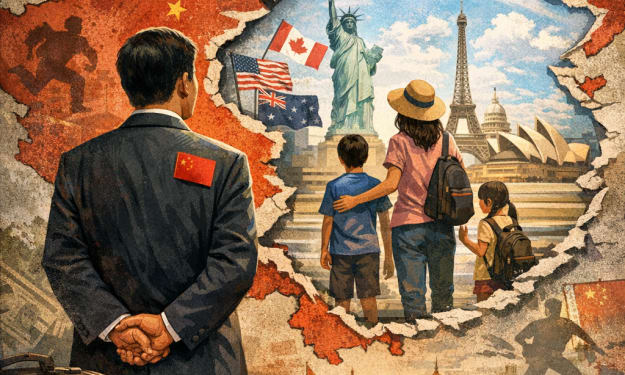
China Naked Official
China’s “Naked Officials”: Power, Corruption, and Capital Flight In Chinese political discourse, the term “naked official” (裸官, luǒ guān) refers to a government official whose spouse and/or children have emigrated abroad while the official remains in China holding public office. The phrase does not imply literal nudity; rather, it suggests that the official is “exposed” — politically vulnerable and potentially more prone to corruption — because their immediate family and often their assets are based overseas.
By Ibrahim Shah 10 days ago in Journal
Writer Tries to Fact-Check Snopes, and Fails Epically
Commentary We live in the age of misinformation. There’s no way to deny it or to avoid it. As the Internet opens its users to a myriad of vital information, it has also exposed them to hyper-partisanship, ideological rants, and outright lies that some Internet sites offer. The situation has gotten so bad that even mainstream media outlets (print, broadcast and the Internet) have been affected by the misinformation propagated by numerous ideological and fake news sites.
By Dean Traylor11 days ago in Journal