
Pakistan's Geopolitical Chess Master
how general aim is playing multiple global powers on one strategic board

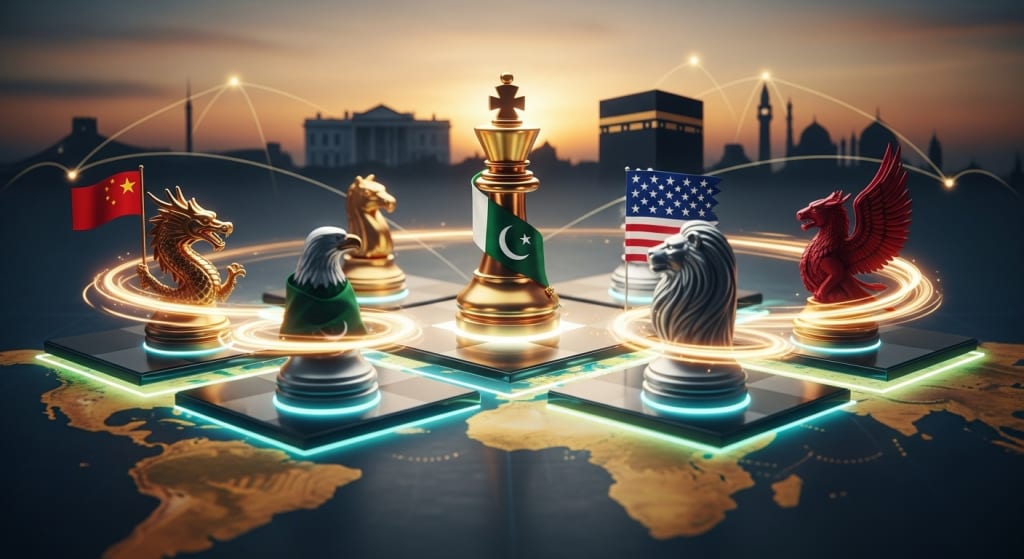
Pakistan: The Chess King Who Keeps the Whole World Guessing ♟️
On the world's most complex geopolitical chessboard, Pakistan is currently making moves so unconventional that even grandmasters are scratching their heads. General Asim Munir sits like a king on the throne, yet his strategies are keeping ministers, ambassadors, generals, and diplomats alike in a state of delightful confusion. In a game where every nation plays for survival, Pakistan isn't just surviving—it's orchestrating.
🇨🇳 Pakistan's Relationship with China: The "All-Weather" Alliance
" You are my 'all-weather friend,'" Pakistan tells Beijing. "The $70 billion China-Pakistan Economic Corridor (CPEC) is your gift to us." And when regional tensions flare—like during Operation Sindoor—China doesn't just send condolences; it shares satellite intelligence. This isn't just diplomacy; it's strategic intimacy. For Pakistan, China represents economic lifelines, infrastructure development, and a counterbalance to Western pressure. But Islamabad knows: even all-weather friends expect loyalty. The challenge? Balancing that loyalty without becoming dependent.
🇺🇸 Pakistan's Relationship with America: The Art of the Photo-Op
General Munir recently enjoyed a two-hour lunch with former President Trump at the White House. There were handshakes, smiles, and a carefully curated photo session. But behind the imagery lies a harder truth: in the currency of geopolitics, Pakistan's greatest asset remains its geography. Nestled between South Asia, Central Asia, and the Middle East, Pakistan is the corridor no power can ignore. Washington wants cooperation on counterterrorism, regional stability, and containing Chinese influence. Pakistan offers engagement—but on its own terms. The message is clear: "We are your old friends, but our interests come first."
🇮🇷 Pakistan's Relationship with Iran: Brotherhood with Boundaries
Foreign Minister Ishaq Dar states it plainly: "Iran is our brother." Pakistan has positioned itself as a neutral mediator, practicing shuttle diplomacy between Riyadh and Tehran. When tensions rise, Islamabad insists: "Pakistani soil will never be used against Iran." This stance isn't just principled—it's pragmatic. A stable Iran means stable borders, reduced refugee flows, and opportunities for energy trade. Yet Pakistan walks a tightrope: too close to Tehran, and Riyadh grows suspicious; too distant, and border security suffers. The solution? Talk to everyone, commit to no one.
🕋 Pakistan's Relationship with Saudi Arabia: Defense Ties and Delicate Balances
Pakistan and Saudi Arabia share a long-standing defense agreement. Riyadh has, at times, hoped for Pakistani military support in regional disputes—including potential confrontations with Iran. But when Iran faced external threats, Pakistan didn't pick sides. Instead, it did something remarkable: it reassured both. To Saudi leaders: "We stand with you." To Iranian counterparts: "We respect your sovereignty." This isn't indecision—it's strategic ambiguity. In a region where alliances shift like sand, Pakistan's ability to maintain relationships with rival powers is its superpower.
🕌 The Real Situation: A Diplomatic Tightrope
United States: "You spoke about building a 'Community of Shared Future' with Iran?"
Pakistan: "Sir, that was just a conference. You remain our old friend."
Saudi Arabia: "You practiced shuttle diplomacy with Iran and didn't inform us?"
Pakistan: "Your Highness, we reassured both sides. What would we gain from your conflict?"
This isn't evasion—it's statecraft. Pakistan understands that in a multipolar world, rigid alliances are liabilities. Flexibility is strength.
🇮🇳 The India Angle: Old Rivalries, New Games
Indian analysts watch Pakistan's moves with suspicion. "This is the old tango," they say. "Trump and Munir may be using each other to checkmate us." Prime Minister Modi has drawn a hard line: "No third-party mediation." Yet Pakistan's diplomatic agility complicates India's strategic calculations. By engaging China, managing the US, and stabilizing ties with Iran and Saudi Arabia, Pakistan isn't just defending—it's reshaping the regional board.
Why Pakistan Stands Alone
Today, Pakistan may be the only country in the world that simultaneously:
- Condemns military aggression against Iran
- Maintains a "major non-NATO ally" status with the United States
- Reassures China that "you are our best friend"
- Keeps Saudi Arabia confident in their partnership
- Promotes joint prosperity initiatives with Tehran
This isn't contradiction—it's calibration. In an era of binary choices, Pakistan refuses to pick sides. Instead, it builds bridges.
The Grandmaster's Smile
When asked about this high-wire act, General Asim Munir reportedly smiled and said: "On the chessboard, the true king isn't the one who makes the most moves—but the one who plays on three boards at once and leaves all four players confused."
That, in essence, is Pakistan's strategy. Not to win every skirmish, but to ensure no single power can dictate the game. Not to choose between giants, but to make itself indispensable to all.
The Bigger Picture
Pakistan's approach reflects a broader truth about 21st-century statecraft: in a fragmented world, neutrality isn't weakness—it's wisdom. Small and medium powers can thrive not by aligning permanently, but by remaining agile, principled, and unpredictable.
Of course, this strategy carries risks. Missteps can alienate partners. Over-promising can lead to under-delivering. And domestic challenges—economic stress, political polarization—can limit diplomatic bandwidth. Yet so far, Pakistan's chess master has kept the pieces in play.
Final Thought
In global politics, as in chess, the endgame matters most. Pakistan isn't trying to checkmate anyone today. It's positioning itself for tomorrow—ensuring that when the board resets, it still has a seat at the table.
And if that means keeping everyone slightly confused? So be it. After all, in chess, confusion is often the precursor to victory. ♟️🇵🇰
About the Creator
Literary fusion
Welcome to literary fusion where art and literature intertwine to create a vibrant tapestry. I am [Abdullah Shabir], an artist and writer exploring self-expression through colors and carefully chosen words.
Keep reading
More stories from Literary fusion and writers in Journal and other communities.
Guard Your Battery
Why are some people so attractive just by standing there? It’s not because they are "likable," but because they don’t need everyone to like them. I realized later that truly charismatic people allow themselves to be criticized, but they never criticize themselves. They never try to please the world; instead, the world stops to watch them.
By Emily Chan - Life and love sharing3 days ago in Poets



Comments
There are no comments for this story
Be the first to respond and start the conversation.