
Iran’s Long War Strategy and America’s Strategic Dilemma
Attrition, Asymmetry, and the Emerging Multipolar Order

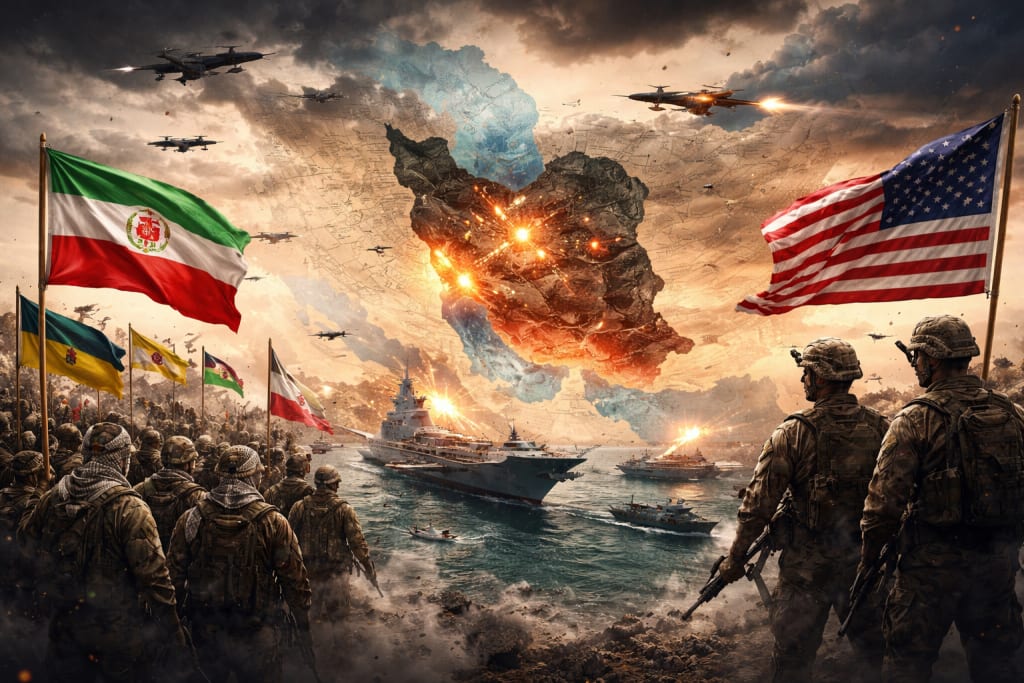
In my assessment, the trajectory of the current confrontation between Iran, the United States, and Israel increasingly resembles a prolonged war of attrition rather than a short, decisive campaign. Unlike rapid, technology-dominated conflicts of the late twentieth century, this confrontation appears structured around endurance, asymmetric leverage, and economic pressure. Iran, in particular, seems to have prepared for such a scenario for nearly two decades—militarily, strategically, and ideologically.
A Two-Decade Preparation for Asymmetric Conflict
Iran’s defense doctrine has evolved significantly since the early 2000s. Rather than attempting to match American military capabilities symmetrically, Tehran invested in asymmetric tools: ballistic and cruise missiles, drone technology, cyber capabilities, and a network of regional non-state allies. This approach avoids conventional large-scale confrontation and instead imposes gradual, distributed costs on adversaries.
Iran’s leadership often frames its geopolitical struggle in ideological language, reinforcing domestic resilience and long-term strategic patience. Preparation for sustained confrontation—rather than quick victory—appears embedded in its planning.
In recent years, limited but intense exchanges have allowed Iran to test missile systems, drone swarms, air-defense responses, and proxy coordination. These episodes likely provided operational data, enabling refinements in targeting, timing, and layered escalation strategies.
The Logic of Attrition
A war of attrition is not about overwhelming force; it is about exhausting the opponent politically, economically, and psychologically. The United States possesses unmatched military power in conventional terms. However, prolonged engagements strain even dominant powers when costs accumulate without clear strategic gains.
One defining feature of modern warfare is cost asymmetry. Defensive systems often rely on multimillion-dollar interceptor missiles to destroy drones or projectiles that may cost only tens of thousands of dollars. While technologically impressive, such exchanges are financially unsustainable if repeated over long periods. Attritional logic favors the actor willing to absorb hardship longer and operate at lower cost.
Iran’s apparent strategy leverages precisely this imbalance—using relatively inexpensive systems to compel expensive defensive responses.
Strategic Pressure on the Gulf Region
A key dimension of this conflict is its potential impact on the Gulf states. The Persian Gulf region contains critical energy infrastructure and maritime routes essential to the global economy. Even the threat of disruption in the Strait of Hormuz can trigger volatility in oil markets and global shipping costs.
Beyond oil, Gulf states rely heavily on desalination plants for freshwater production. In several countries, a majority of potable water originates from such facilities. These installations, while technologically advanced, are geographically fixed and potentially vulnerable to drone or missile strikes. Even limited disruptions could create severe humanitarian and economic pressure.
Energy facilities, shipping lanes, ports, and digital infrastructure form an interconnected web. Disruption in one area cascades into others—energy exports decline, revenues drop, currency stability weakens, and global markets react. In an interconnected world economy, targeted regional instability can generate global ripple effects.
Petrodollars, Capital Flows, and Financial Stability
For decades, the global energy trade has been closely linked to dollar-denominated transactions. Oil revenues accumulated by Gulf states have historically flowed into U.S. financial markets, sovereign debt instruments, and large-scale investment projects.
Today, a significant portion of global capital is concentrated in advanced technologies, including artificial intelligence infrastructure and data centers. While Gulf capital is not the sole driver of these investments, it represents an important stream within a broader financial ecosystem.
If regional instability were to significantly disrupt oil exports or reduce sovereign investment flows, global markets could face heightened volatility. However, predictions of automatic systemic collapse oversimplify a far more diversified and resilient financial structure. The United States retains structural advantages: deep capital markets, reserve currency status, and technological leadership. Nevertheless, prolonged instability could weaken confidence and accelerate movement toward a more multipolar financial order.
Is the U.S. Military Structured for 21st-Century Warfare?
The American defense architecture was shaped during the Cold War, emphasizing technological superiority, air dominance, aircraft carrier strike groups, and precision-guided munitions. While these systems remain formidable, modern conflicts increasingly feature hybrid warfare: drones, cyberattacks, proxy militias, economic coercion, and information campaigns.
The issue is not a lack of capability, but sustainability and cost efficiency. Advanced platforms are extraordinarily effective—but also extremely expensive. In a prolonged contest against lower-cost systems, maintaining operational sustainability becomes strategically critical.
Airpower Versus Ground Realities
History suggests that airpower alone rarely produces regime change. Strategic bombing can degrade infrastructure and impose economic costs, but durable political transformation typically requires internal collapse or ground-level shifts in power.
A large-scale ground invasion of Iran would present enormous risks due to geography, population size, terrain, and potential regional escalation. Domestic political opposition within the United States to extended ground wars further complicates such an option.
As a result, policymakers may remain confined to intensified air and maritime operations without crossing into full-scale invasion—creating a prolonged gray-zone conflict rather than decisive victory.
Regional Power Competition
Israel and Saudi Arabia both view Iran as a significant strategic rival, though for different reasons. For Israel, Iran’s missile capabilities and support for regional armed groups represent direct security concerns. For Saudi Arabia, Iran embodies geopolitical and ideological competition for regional influence.
Saudi Arabia’s economy remains heavily energy-dependent, despite diversification efforts into tourism, technology, and large-scale development projects. Regional instability threatens these transformation plans, shaping Riyadh’s security calculations.
Possible Drivers of Escalation
Why might such a conflict intensify despite high risks?
Strategic overconfidence — major powers sometimes overestimate their ability to manage escalation.
Domestic political incentives — leaders may perceive short-term political advantage in strong military posturing.
Deterrence signaling — escalation may be seen as necessary to maintain credibility.
Serious geopolitical analysis should focus on verifiable structural factors: balance of power, economic interests, alliance systems, and domestic political pressures.
Toward a Multipolar Order
Whether or not this confrontation escalates further, a broader trend is evident: the global system is moving toward greater multipolarity. The relative dominance of any single power is increasingly constrained by economic interdependence, technological diffusion, and regional balancing coalitions.
If the conflict remains limited, it may reinforce deterrence without systemic breakdown. If it expands, it could accelerate financial diversification, deepen regional fragmentation, and reshape global energy trade routes.
Conclusion
This conflict is less about immediate battlefield victories and more about endurance, economic leverage, and strategic patience. Iran appears structured for prolonged asymmetric resistance. The United States retains overwhelming conventional superiority but faces sustainability challenges in a protracted, cost-imbalanced confrontation.
The decisive question is not who can strike harder—but who can endure longer without destabilizing their own political and economic foundations. In the twenty-first century, power is no longer measured solely in firepower. It is measured in resilience.
Share your opinion in the comment section. What are your thoughts on this evolving world situation?
About the Creator
I wanted to title this something different, but worried that my chosen title might cause problems entering the United States in the future so this is the new title. It's the greatest title. No one has ever written a title better than this. (All titles unrelated to content).
Let me be honest. I am finding this difficult. Now, I like a challenge, a stretch, a bit of an obstacle course. “Write about the decline of the British Empire in the form of a narrative poem in which your protagonist is an artichoke” I read, and flex my fingers. “Write a haiku to evoke the sensation of sibilance using only the first half of the alphabet.” “Well”, I think to myself, “this should be fun.” But “write about a system that isn’t working”? A system that isn’t working? Now? In 2026? ONE system? My favourite system that isn’t working? The sexiest system that isn’t working? The one giving me the most angst day to day? The one giving me the most existential dread? I am, as I say, finding this difficult. I will own that I have contemplated writing a thousand words on why the steady “all on” setting on my fairy lights is the EIGHTH of seven options which must be sequentially activated to get there, because that is a system that some fool came up with and it definitely doesn’t work, and now who is paying the price, eh? But how can I write about my fairy lights when…. When…. When….
By Hannah Moore5 days ago in Humans


Comments
There are no comments for this story
Be the first to respond and start the conversation.