disorder
The spectrum of Mental Health disorders is incredibly vast; we showcase the multitude of conditions that affect mood, thinking and behavior.
Excerpts of Torture
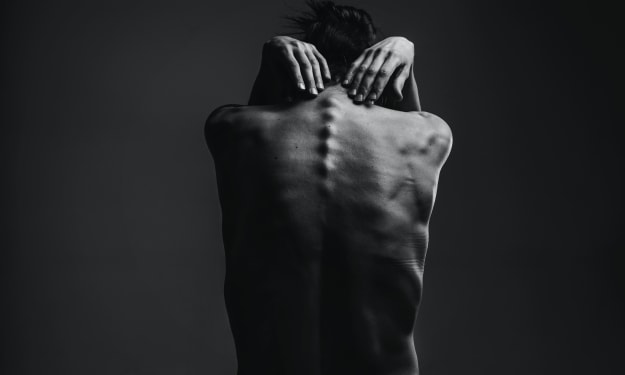
“Bulimics- weak. Over-exercisers- very weak. Diet pill takers- the weakest. None of them have shit on us. We’re the ones with discipline. We’re the ones with strength. Why? Because we combine all three of them and then add another, stronger component to it. We starve. We are the ones who stare into the refrigerator with sunken eyes and a weak heartbeat, longing to put one morsel into our mouths, even the healthiest of foods, and cannot bring ourselves to consume anything. It’s at that point we punish ourselves for even walking into the kitchen. “Ok, you, stupid weakling,” we say to ourselves. “It’s time to repent.” That means we’ll go even longer without a single bite, take twice the number of pills, and do twice the exercise we normally do, just because we walked into the kitchen and even contemplated eating. Hell, at least the bulimics vomit the food up. The other two actually consume it completely and let it nourish their bodies, even if it’s only temporary. Us, we don’t even swallow, which, to be brutally honest, doesn’t come in handy at some point in life when you’re staring up at the face of a guy eagerly awaiting you to consume him while your knees ache from the pressure of the floor beneath them. But that’s another story altogether; I simply say it to further explain how our road is more difficult, but, oh, the triumph is greater, the results more permanent. Yes, we anorexics have a hard line to tow, but when you can walk into the children’s section of a clothing store and buy a smaller size than a child years younger than you, it’s all worth it.
By Kayla Evans6 years ago in Psyche
Bad news and Gratitude
Another sunrise in North America. Fuzzy vision met with the subtle call from a small dead screen on the side table. What is the date? What time is it? An anonymous spine fuses to the coils shaping the mattress. Consciousness returns, in lieu of life. Another day.
By Deborah Alice6 years ago in Psyche
Body Dysmorphia is a B*tch
I’m sure most of us have had thoughts of wishing a part of our body looked different, our hair was thicker, or our eyes were a different color -- because, who hasn’t, right? For me, I wish my boobs were a little bigger, more perky. I wish my bikini line didn’t get such bad razor burn. I wish my teeth were straighter, whiter. There are many physical characteristics I’d like to change, but I’ve also learned how to accept myself just the way I am. That’s not to say I don’t still have those thoughts, because I do. And I’m sure you’ve experienced them a time or two as well. What’s important is to be aware of how often and how extreme those thoughts occur.
By Shaley Speaks6 years ago in Psyche
How Quarantine Affected My Eating Disorder
The first time I thought I took up too much space was when I was nine-years-old. It was silent reading time in Mrs. Boucher's class and children were seated in groups of four. Slouched in my chair, I looked at my stomach rolls in my pink Hollister t-shirt and cleverly placed my book to hide them. That was 15 years ago. I've silently battled eating disorders for eight years.
By Hallie Manchester6 years ago in Psyche
The A Word
Self-isolation and lockdown has been tough. We haven’t been able to see our loved ones, our family or our friends. The fear of contracting Covid-19 has been at the peak of everyone’s worries with thousands of people stockpiling food and hand sanitiser, frantically scrubbing their hands and wearing face masks twenty-four-seven. Life has been hectic for the NHS, uncertain for millions of workers and completely up in the air for school kids, but what about the issues the virus has caused for people with Asperger’s Syndrome?
By Stand Corrected Editing6 years ago in Psyche
My Body Dysmorphia and Social Media
Body insecurity is common among most of us, maybe our shape is something we don't like, it could be our face symmetry or skin issues. For some they can "cope" with their insecurities but for others like me this becomes an obsession and debilitating to their daily lives. Body Dysmorphic Disorder (BDD) is described by the Diagnostic and Statistical Manual of Mental Disorders, fifth edition as a "diagnosis involving distress due to a perceived physical anomaly, such as a scar, the shape or size of a body part, or some other personal feature". OCDaction.org state that "According to the NICE guidelines, it is estimated that approximately 0.5-0.7% of the UK population have BDD. Clinical samples tend to have an equal proportion of men and women across all age groups. In children and young people, body dysmorphic disorder usually has an early-adolescence onset at about age 13. Although symptoms can be found in children as young as 5, it is rare for children under 12 to be diagnosed with BDD. "
By Ruby-Jessica Smith6 years ago in Psyche
By Proxy
A young mother reported her son missing in June of 2001 and she never saw him again. She was walking to the park with her son in her arms. Loosening her arms to let him down and play. He was only two years old at the time, curious about everything and anything that was around him. His name was Liam Cooper, named after his grandfather. The young mother turned around to go get something from her bag and to sit down to watch her son play. That was the biggest regret that she has from that day. She turned back around and Liam was gone. She couldn’t find him anywhere. It was like he was never there, to begin with.
By Natalie C..6 years ago in Psyche