
North Korea fires ballistic missiles as US-South Korea hold military drills
North Korea launches multiple ballistic missiles into the sea as U.S.–South Korea joint military drills escalate tensions on the Korean Peninsula.

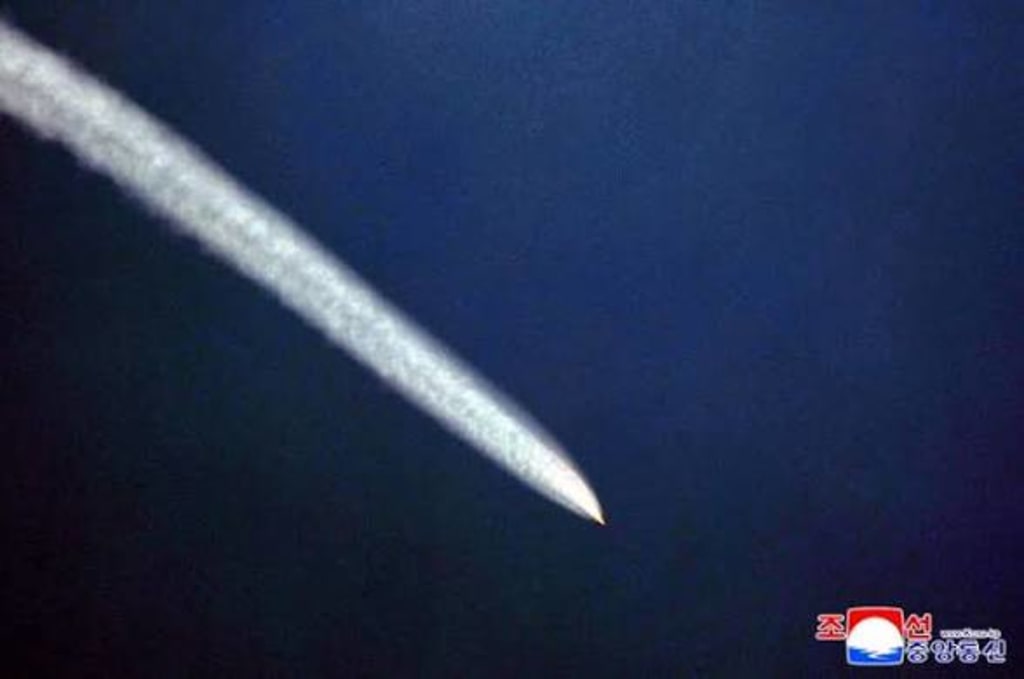
North Korea on March 14, 2026 fired approximately 10 ballistic missiles into the sea off its east coast, coinciding with large‑scale joint military exercises by the United States and South Korea — a move that dramatically underscores escalating tensions on the Korean Peninsula.
According to South Korea’s Joint Chiefs of Staff, the missiles were launched from near Pyongyang around 1:20 p.m. local time and splashed down in waters of the East Sea (also known as the Sea of Japan) without landing inside Japan’s exclusive economic zone. Japanese authorities reported detecting potential missile activity, but no debris or damage was confirmed in Japanese waters.
The launches occurred as U.S. and South Korean forces conduct the annual “Freedom Shield” exercises, which began earlier in March and are scheduled to continue through much of the month. The allies describe the drills as routine and defensive, intended to enhance combined readiness and interoperability against threats from the North.
Pyongyang’s Response and Rhetoric
North Korean state media and officials have routinely condemned these joint exercises, portraying them as hostile provocation and rehearsals for invasion. In statements ahead of the drills, Kim Yo Jong — sister of North Korean leader Kim Jong Un — warned that the scale and scope of U.S.–South Korea military activities threaten regional stability and could yield “terrible consequences.”
Pyongyang often uses major allied training events as a pretext to conduct weapons tests, including ballistic and cruise missile launches. Analysts say this pattern serves multiple purposes: demonstrating military capability domestically and internationally, signaling defiance against perceived threats, and attempting to extract political leverage.
Military and Regional Dynamics
The Freedom Shield exercises involve U.S. forces based in South Korea — estimated at about 28,500 troops — and significant South Korean military units. Activities include large‑scale manoeuvres that simulate cross‑river operations with tanks, armoured vehicles and air support. These positions aim to deter aggression and maintain combat readiness in what remains one of the world’s most militarised regions.
From Seoul and Washington’s perspective, the drills reaffirm the strength of the U.S.–South Korea alliance and the commitment to defend the South in the event of an attack. Officials emphasise that the exercises are defensive in nature and not conducted with offensive intent toward Pyongyang.
Nevertheless, North Korea’s military leaders view them through a different lens, depicting the drills as preparations for regime change or invasion. In previous years, similar joint operations have prompted Pyongyang to fire short‑range missiles or conduct naval and ballistic tests as a demonstration of its own capabilities.
Diplomatic Calculus and Missile Development
The latest launches come amid complex diplomatic undercurrents. In the days before the drills began, South Korean Prime Minister Kim Min‑seok met with U.S. President Donald Trump in Washington, where leaders discussed the potential for renewed engagement with North Korea. Trump reportedly expressed willingness to resume dialogue with Kim Jong Un, raising the possibility of future negotiations despite the missile provocations.
North Korea’s persistent missile development — including short‑range, intermediate‑range and longer‑range systems — has long been a central concern for regional and global security. These weapons, which Pyongyang continues to test frequently, are seen as core elements of its deterrent strategy and a means of compelling diplomatic concessions.
Reactions from Neighbours and the International Community
Nearby countries including Japan, China and members of the Association of Southeast Asian Nations (ASEAN) have closely watched the escalating activity on the Korean Peninsula. Tokyo has repeatedly urged restraint from all parties, emphasising the importance of avoiding miscalculations that could trigger conflict. Beijing, which maintains official ties with Pyongyang, frequently calls for de‑escalation and resumption of dialogue to manage regional security.
In Seoul, South Korean officials confirmed that no casualties resulted from the missile launches and that the launches did not significantly disrupt the ongoing military drills. Leaders stress that the alliance remains resolute and that the drills will proceed as planned.
Looking Ahead
The latest missile launches signal a continuation of entrenched patterns in which North Korea uses military demonstrations to counter allied exercises. While the immediate risk of direct confrontation remains limited, the situation complicates diplomatic efforts to reduce tensions and resume broader negotiations on denuclearisation and security assurances.
As the Freedom Shield exercises progress, global eyes will remain trained on developments along the Korean Peninsula, where military manoeuvres and missile tests continue to shape the delicate balance of power in Northeast Asia.
About the Creator
Fiaz Ahmed
I am Fiaz Ahmed. I am a passionate writer. I love covering trending topics and breaking news. With a sharp eye for what’s happening around the world, and crafts timely and engaging stories that keep readers informed and updated.
Keep reading
More stories from Fiaz Ahmed and writers in The Swamp and other communities.
Success uncertain, but Israelis continue to back ‘heroic’ war with Iran
Tens of thousands of Israelis continue to express strong support for their country’s military campaign against Iran, even as doubts grow about the war’s ultimate objectives, costs and outcomes. According to a March 2026 poll by the Israel Democracy Institute, roughly 82 – 93 % of Israelis — particularly Jewish Israelis — support the ongoing conflict with Iran, a level of consensus that crosses traditional political divides. That backing includes many who have historically opposed Prime Minister Benjamin Netanyahu’s government, who now describe the campaign as a necessary defence against Tehran’s long‑standing threats. A Nation Rallying Around the Flag The war, which escalated after a series of Israeli strikes deep inside Iranian territory, has largely united public opinion behind the government. Within Israel, many citizens view the campaign not only as a defence of national security but as a “heroic” initiative to dismantle Iran’s capabilities and prevent future threats. Mainstream political parties, including many in the centre and moderate right, now publicly support the war effort — often with little political dissent. Political analysts describe this phenomenon as a classical “rally‑round‑the‑flag” effect, where public opinion consolidates during wartime irrespective of the government’s overall popularity. Within Israeli society, foreign policy and security threats — particularly those tied to Iran’s nuclear and missile programmes — have long dominated the national consciousness. In Tel Aviv, veteran activist Alon‑Lee Green of the Palestinian‑Jewish advocacy group Standing Together noted that efforts to protest the war were met with rapid police intervention, reflecting both the high level of public support and a sensitive atmosphere around dissent during active conflict. Leadership Frames War as Existential and Historic Prime Minister Netanyahu, speaking from Jerusalem, has repeatedly framed the operation against Iran as not just a tactical military endeavour but a defining moment in Israel’s history. In public addresses, he has described the campaign as one that will be “recorded in the annals of Israel” and one fought for the security of future generations. In these speeches, the struggle against Iran is often placed in existential terms — as defending the nation from decades of hostile rhetoric and regional interference. Netanyahu’s messaging resonates particularly strongly among older generations who remember repeated threats from Iran’s leadership and proxy militias. For many Israelis, memories of past wars and missile attacks from Lebanon and Gaza inform their acceptance of expansive military action. Uncertainty and the Lack of Clear Endgame Despite overwhelming public support, there is growing unease — among experts and some politicians — about the lack of a well‑defined strategy for achieving long‑term goals in Iran. Even within Israeli security circles, questions have emerged about how a prolonged campaign, focused on airstrikes and targeted operations, might lead to meaningful regime change in Tehran, or whether the country could instead become entrenched in a drawn‑out conflict with unpredictable regional consequences. Israeli officials themselves acknowledge that success is not guaranteed. While military operations have reportedly degraded Iran’s nuclear and missile‑related infrastructure, analysts point out that dismantling these capabilities entirely — let alone securing the collapse of Iran’s political leadership — remains uncertain. Iranian authorities, despite suffering high‑profile losses, including the killing of Supreme Leader Ali Khamenei in late February, have maintained internal control and continued retaliatory operations. More broadly, strategic analysts say that Tehran’s decentralised defence doctrine — designed to absorb shocks from heavy bombardment and stay operational — makes it unlikely that short‑term military actions will achieve decisive victory. Instead, these analysts argue that Iran may be prepared for a long, attritional conflict that external military force alone cannot quickly resolve. Political and Regional Implications The domestic political landscape in Israel has also shifted. Opposition figure Yair Lapid has publicly said that he no longer intends to pursue no‑confidence motions against Netanyahu’s government amidst the war, reflecting how national security concerns have overshadowed traditional partisan disputes. Regionally, the conflict has triggered broader instability. Israel’s ongoing military activities have overlapped with fighting in Lebanon, where the militant group Hezbollah has escalated hostilities, and tensions continue across the Middle East as neighbouring states grapple with the conflict’s ripple effects. Internationally, leaders have responded with mixed messaging. While the United States, under President Donald Trump, has expressed support for Israel’s actions and claimed progress in degrading Iran’s capabilities, several European leaders have urged a return to diplomacy to avoid a wider regional conflagration. A War Without a Clear Ending in Sight For ordinary Israelis, the war’s human and economic costs — compounded by global energy market volatility and regional civilian casualties — are often viewed through the prism of long‑term national security. Yet beneath widespread support lies a complex calculus: a recognition that decisive victory may be elusive and that the path to a stable Middle East might require more than military force. As the campaign continues, both the government and the public are left to weigh short‑term achievements against the uncertainties of an open‑ended war, where the outcome is not predetermined and the consequences echo far beyond Israel’s borders.
By Fiaz Ahmed 2 days ago in The Swamp
The Forsyth House Fire
Since 1851, Forsyth House has stood on the corner of Union Street and Gordon Street in the heart of Glasgow. Its iconic, or was... because on Sunday 8th of March, 2026, a fire broke out in a small, seemingly un-named shop in the building and tore all that history down. As I write, the rubble is still unsettled and the street is still blocked off. Central Station is quiet on the upper level, and around 30 small businesses have quite literally gone up in smoke.
By S. A. Crawford3 days ago in The Swamp



Comments
There are no comments for this story
Be the first to respond and start the conversation.