congress
A handy guide to all Congress happenings on both sides of the aisle. Thank goodness for this political body that keeps Presidential power in check.
UPS Plane Crash in Louisville: Tragedy at Muhammad Ali International Airport
Louisville, Kentucky — What began as a routine cargo flight for UPS turned into a scene of tragedy early this morning when a McDonnell Douglas MD-11 cargo plane crashed near Muhammad Ali International Airport (SDF) in Louisville. The accident has sent shockwaves through the aviation community and prompted a full-scale investigation by federal authorities.
By KAMRAN AHMAD4 months ago in The Swamp
The Mirror That Shattered
The internet’s obsession wasn’t with her outfit or presence — it was with her face. Comparisons flooded social media. Side-by-side photos of Meghan from her Hollywood years and her recent public outing became digital autopsies, each pixel examined for signs of change. The conversation quickly moved from admiration to accusation: Had she gone under the knife?
By Behind the Curtain4 months ago in The Swamp
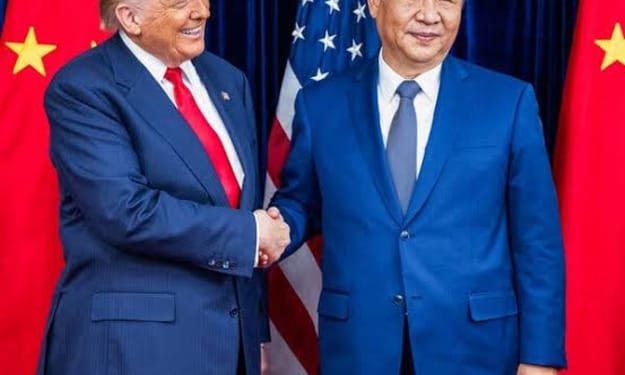
🇺🇸🤝🇨🇳 “US–China Trade Deal Nears Completion: Could It Redefine Global Politics?” By Kareem Kochi | Political Analysis | October 2025
🌏 Introduction: A New Chapter in Global Diplomacy In recent weeks, the world’s attention has once again shifted toward the corridors of power in Washington and Beijing. Former U.S. President Donald Trump and Chinese President Xi Jinping have reportedly made significant progress toward finalizing a new trade and technology agreement — one that could reshape the very foundation of international politics and economics.
By Filmon Ke Raaz | Movie Mysteries Explained4 months ago in The Swamp
Why Trump Doesn’t Care About Climate Change?
Donald Trump, the current president of the United States, remains one of the most polarizing figures in modern politics. His position on climate change has sparked worldwide criticism, yet it perfectly aligns with his political identity and personal philosophy. Trump is a right-wing politician, a nationalist, and above all, a businessman who sees the world through the lens of profit and power rather than sustainability and science. His refusal to take climate change seriously is not accidental; it reflects his deep commitment to economic nationalism and his belief that environmental concerns should never outweigh America’s industrial and financial interests.
By Keramatullah Wardak4 months ago in The Swamp
“My Heart Stayed Calm Through Horror”. Content Warning.
How about a comparison of horror movies to the horror going on in America, lighthearted, I watched a horror movie last night, to my surprise my heart was not racing. I turned on the news about the ice terrorism and the horrors of Whitehouse being gutted so I turned the news off, turned on a horror movie again. I watched five horror films; my heart was pure at 82 beats a minute. I turned on the news again about tear gas sprayed on Halloween party together in a park, with children and knocking down old people, I said fuck it watched another horror film. what a relief to watch The Conjuring again and not the horrifying evil penetrating from the nazis in DC.
By Vicki Lawana Trusselli 4 months ago in The Swamp
Is the Government Shutdown Real?
Remember when Trump kept saying "Fake News" and everybody called him the Anti-Christ for saying that? They mocked him, hated him, and called him all kinds of bad things because he was pointing out the FACT that many people were unaware about how much nonsense they accept as truth just because it came from the television or the "News" reporters. Do we still feel that way or have more people begun to realize that we have no idea what is true or false anymore? I have to admit that for the portion of my life that I call the "young years" it was really nice believing that I knew everything or at least that I knew enough to discern between fact and fiction. These days, I have no idea. Unless it actually occurred to me or to my witness, I have no idea who is truthing or fibbing. Like this "Government Shutdown" thing ---- What the heck are they talking about?
By Shanon Angermeyer Norman4 months ago in The Swamp
Government Shutdown 2025
The United States is currently experiencing a government shutdown for the first time in nearly seven years that began on October 1st, 2025, a situation that has far-reaching consequences for federal operations, employees, and citizens across the country. As we trudge through the third week of the shutdown, let’s take a look at the causes behind it, its immediate and long-term impacts, and the potential paths toward resolution.
By Shaley Speaks4 months ago in The Swamp
What the U.S. Wants from Venezuela?
In recent months, tensions between the United States and Venezuela have sharply escalated, bringing the two countries once again into the global spotlight. U.S. military vessels patrolling near Venezuelan waters, a series of strikes under the pretext of counter-narcotics missions, and mutual accusations in the United Nations have reignited the question: What does the United States really want from Venezuela?
By Keramatullah Wardak4 months ago in The Swamp
How the United States Was Formed: From Colonies to a Global Superpower
Discover how the United States emerged from its colonial roots to become a global superpower. This article explores the key events that shaped the nation — from the struggles of early settlers and the Revolutionary War to the creation of the Constitution, industrial growth, and America’s rise as a world leader.
By Filmon Ke Raaz | Movie Mysteries Explained4 months ago in The Swamp
Senator Jeff Merkley’s Announcement
October 22, 2025. Jeff Merkley (D) from Oregon, stood on the Senate floor during a federal government shutdown for nearly 24 hours to share an important announcement: An Authoritarian Government in the United States is no long coming, but here.
By Iris Harris4 months ago in The Swamp
Trump hopes to put an end to Russia’s war without selling Tomahawks to Ukraine
Previous U.S. By announcing that he intends to put an end to the conflict between Russia and Ukraine without deploying sophisticated American weapons, particularly Tomahawk missiles, to Kyiv, President Donald Trump has once more attracted the attention of the entire world. His most recent statement comes as Washington's debate over how to strike a balance between military assistance and diplomatic intervention grows. Trump, who is known for taking a different approach to foreign policy, insists that peace can be achieved through "strong negotiation and respect" rather than providing an endless supply of weapons. Trump said at a rally in Ohio that if he was elected, he could end the conflict between Russia and Ukraine "within 24 hours." He argued that where current leadership has failed, his administration's diplomatic style, based on leverage and mutual understanding, would succeed. Trump declared, "We don't need to sell or send Tomahawks to Ukraine to stop this war." "We need smart leadership that gets Putin and Zelenskyy to sit down together, not one that keeps fueling war," says the author. His remarks set off a political firestorm in a short amount of time, prompting harsh criticism from Democrats and Republicans who fear withholding military assistance would empower Moscow. The United States' Tomahawk missile, a long-range precision weapon The Navy has come to represent American military might. In light of the intensification of Russian strikes in the eastern and southern regions, Ukraine's allies have discussed the possibility of providing such advanced systems to bolster Kiev's defenses. However, Trump's position departs significantly from the current strategy of the Biden administration, which places an emphasis on continuing to transfer weapons to support Ukraine's resistance. Trump's position, according to critics, understates the war's complexity and the Kremlin's threat. They argue that Ukraine may face overwhelming odds if it does not receive consistent Western military assistance. However, Trump's supporters see his stance as pragmatic and in line with a growing number of U.S. voters who are tired of being involved in foreign affairs. Debate over whether such expenditures truly serve national interests has been sparked by the war's cost in billions of dollars to taxpayers in the United States. Trump's doctrine on foreign policy, which is frequently referred to as "America First," has long emphasized lessening the United States' involvement in long-running conflicts overseas. During his presidency, he criticized NATO members for not contributing enough to their own defense and advocated for troop withdrawals from Syria and Afghanistan. His most recent comments regarding Ukraine follow the same pattern, putting diplomacy ahead of intervention. He stated, "We need peace through strength, not interminable wars through weakness." Diplomats say that Trump's plan to end the war between Russia and Ukraine would probably involve high-level talks and conditional rewards for both sides. In exchange for a ceasefire, he may, according to some, offer Russia relief from some sanctions and encourage Ukraine to accept security guarantees rather than territorial gains. However, others warn that a deal of this kind might jeopardize Ukraine's sovereignty and legitimize Russian aggression. There has been a variety of international reaction to Trump's statement. Although they have not provided any direct comments, Russian officials have previously stated that they would welcome any American leader who is willing to engage in dialogue. In the meantime, officials in Ukraine deemed Trump's claim that he could end the war in one day to be untrue. A spokesperson for the Ukrainian government stated, "We appreciate any effort for peace," but "ending a war started by invasion requires more than negotiation slogans." Despite skepticism, some segments of the American electorate who are dissatisfied with the war's economic effects have found resonance in Trump's remarks. Voters are feeling worn out as a result of inflation, rising energy costs, and spending on defense. Due to the fact that the conflict does not appear to be coming to an end immediately, polls indicate that a growing number of Americans would rather see diplomatic solutions than military escalation. Trump's comments also serve as a strategic campaign message as the 2024 election nears. He wants to set himself apart from President Joe Biden, who continues to support Ukraine militarily, by portraying himself as a dealmaker who can end wars without weapons. Trump sees the idea of resolving the crisis without using Tomahawks or selling them as a sign of fiscal restraint and global influence. It is still unknown whether his strategy would truly bring peace. The territorial disputes, national identities, and geopolitical rivalries that go far beyond simple negotiation are at the heart of the conflict in Ukraine. Nevertheless, the topic of the significance of diplomacy in contemporary warfare has been brought back up by Trump's resolute assertion. The broader question of whether U.S. leadership can shift from weapons to words and still maintain global strength is emphasized by his promise to end the conflict "without firing a single missile."
By GLOBAL NEWS5 months ago in The Swamp