
The First Casualty Of War Is The Truth
Wartime Narratives often change or evolve

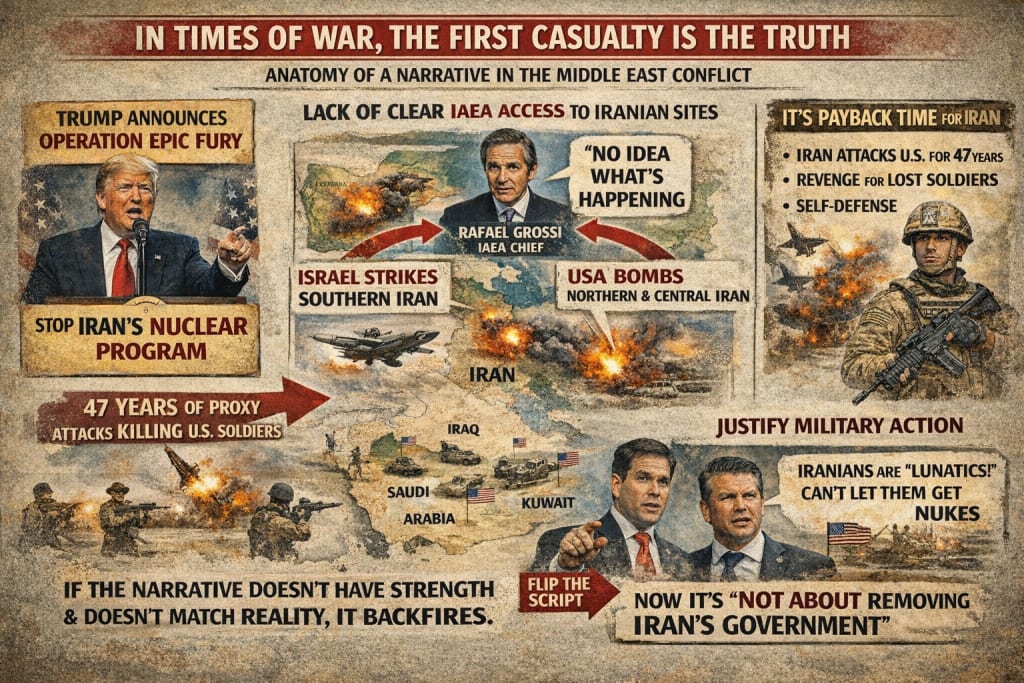
It is often said that in times of war, the first casualty is the truth. When Donald Trump launched Operation Epic Fury, he said that the goal was to stop Iran from developing nuclear weapons. At the same time, when the head of the International Atomic Energy Agency (IAEA), Rafael Grossi, was asked about it, he said that they do not even have access to the sites. Therefore, they have no clear idea about what is happening there, and he appeared somewhat confused.
In the southern part of Iran, Israel is carrying out strikes, while in the northern and central parts, the United States is conducting bombing operations. This raises an important question: if there really are nuclear sites there, then that is one issue. But the Americans also offered another justification. They said this is payback time for Iran, because for the past 47 years Iran has been attacking American soldiers.
However, no attack on American soldiers has taken place inside U.S. territory or directly on U.S. bases in America. What they mean is that through the years, various proxy conflicts have occurred in the Middle East and in regions where the United States has military assets. In those tit-for-tat exchanges, if an American soldier was killed, the blame was placed on Iran. According to them, the United States has now come to take revenge for those losses.
They then said that since American soldiers were killed, this action is self-defense. In this way, they described the operation as an act of self-defense.
Israel was going to carry out strikes anyway, and American troops were bound to become involved. But a justification had to be presented to the public. At that moment, the narrative had not yet settled in the minds of people that this was America’s war. Then it was said that the United States is here to remove the Iranian government, that regime change in Iran is necessary.
But within a day, that statement changed. It was then said that this war is not about removing the Iranian government.
Now the words being used by Marco Rubio and Pete Hegseth are very extreme. They say that Iranians are “lunatics,” and that the world cannot allow such “lunatics” to obtain nuclear weapons.
This script feels very old. It reminds me of the many vlogs and discussions I have done during the Pakistan–India war periods and at other times as well—about the importance of narrative.
Especially in wartime, if your narrative has no strength, if it does not match reality, then it will fail and may even backfire.
According to the narrative presented, the United States claimed that its objective was to prevent Iran from developing nuclear weapons. However, the head of the International Atomic Energy Agency (IAEA), Rafael Grossi, indicated that inspectors did not have full access to certain Iranian sites, meaning there was uncertainty about what was actually happening on the ground.
The discussion also describes how military strikes were reportedly taking place in different parts of Iran, with **Israel targeting areas in the south and the United States conducting operations in northern and central regions. Another justification presented by U.S. officials was that the action was “payback” for decades of attacks on American soldiers through proxy conflicts in the Middle East, framing the operation as self-defense.
At different moments, the messaging appeared to shift. Initially, some statements suggested that regime change in Iran might be necessary, but later officials clarified that the goal was not to remove the Iranian government. Political figures such as Marco Rubio and Pete Hegseth used strong language to argue that Iran should not be allowed to obtain nuclear weapons.
Overall, the discussion emphasizes that wartime narratives often change or evolve, and if the official explanation does not align with facts or public perception, it can weaken credibility and even backfire politically.
About the Creator
Ibrahim Shah
I am an Assistant Professor with a strong commitment to teaching,and academic service. My work focuses on fostering critical thinking, encouraging interdisciplinary learning, and supporting student development.
Keep reading
More stories from Ibrahim Shah and writers in The Swamp and other communities.
U.S. strategic competition with China.
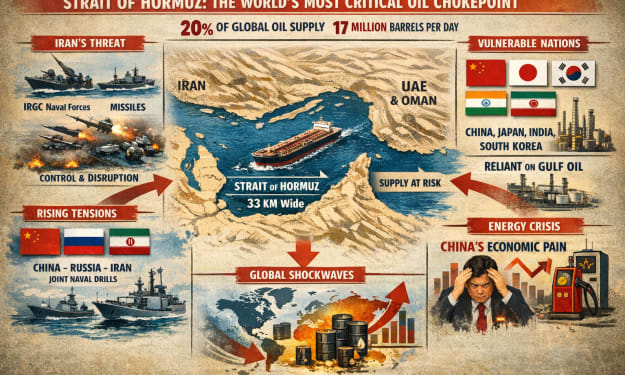
This war Stop being a medley story the moment the first oil tanker changed course in the Persian Gulf. What I mean is, Strait of Hormuz is the most important energy bottleneck on earth. Everybody knows it is the most important energy bottleneck on earth. And if it was the threat from Iran last time, this time Iran has partially done it. It is so narrow, IRGC has a lot of control over it. Just like in the Strait of Malacca, army/navy has control over it. Similarly, here the Iranians have control over it. And recently, China, Russia, and Iran have already conducted war games. So it is this narrow, 33 kilometers wide, you are hearing about it everywhere, everybody is talking about it. It is the width of a large city. So in this narrow passage, which holds 20% of the world's oil, one fifth of the world's oil and gas goes through, it is around 17 million barrels per day. There is no realistic alternative route except the Strait of Hormuz. If we close this passage, its consequences will not stop at any one border. Europe will pay, Japan will pay, India, South Korea, China, everybody pays the price. So a theory is floating around, which backs my argument that China is the target. It is that in Washington circles, there is a discussion going on, let's be honest, if this happens, what do we have to do? The hawkish people there say that this disruption should be allowed because it does not impact them as much as it impacts those countries, which I have just mentioned. So let's take this opportunity that the slowdown of China's energy supply can be slowed down. Trap Beijing in such an expensive moment as long as this congestion remains in the Strait of Hormuz, it remains closed, partially or completely. Iran keeps Beijing hit very badly from an energy security point of view. So the containment policy of China that is already going on is an added bonus. So imagine, on one hand, you are doing everything with technology and trade, imposing tariffs, treating them in the South China Sea, imagine all this. And from the other side, almost 90% of the oil and gas supplies go to China. If it is blocked for a few days, how badly it will hit China. So imagine, while the world is suffering, they are only having strategic designs in their minds.
By Ibrahim Shah 2 days ago in The Swamp
Parallel Protests
I haven't written for quite some time, but I have A LOT of thoughts about yesterday's protest rally against our government's involvement and complicity in America's war on Iran, on the harbourside of my home city Bristol, and I need to put them somewhere. My gorgeous girlfriend is always a loving and listening ear and sharing it all with her will always be a healthy and happy way of processing the mental and emotional weight, but getting it straight in my brain to share means writing it all down in straight lines, so, here we are and thanks for being here.
By Steph Cole6 days ago in The Swamp
US jet fighter downed over Kuwait 'was UK-based
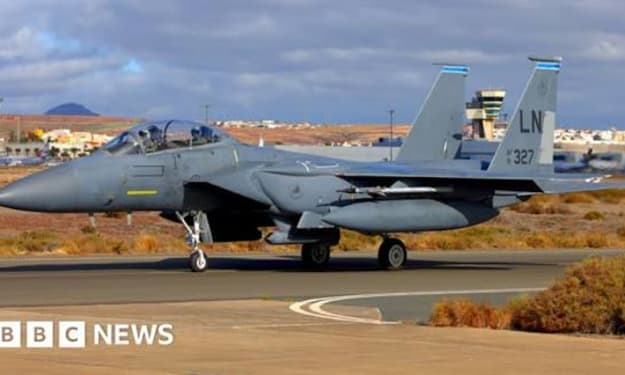
At least one of the United States Air Force fighter jets that was downed over Kuwaiti airspace in early March appears to have been based in the United Kingdom, according to emerging evidence from open‑source imagery and reconstruction by independent analysts. The revelation adds a new layer to an already sensitive and complex episode in the ongoing regional conflict involving the U.S., Iran, and allied forces. The fighter jet in question was one of three U.S. F‑15E Strike Eagle aircraft that were mistakenly shot down over Kuwait on March 1, 2026, during what U.S. Central Command (CENTCOM) has characterized as an “apparent friendly fire incident” amid intense aerial operations. All six aircrew members ejected safely and were recovered in stable condition. Initial statements from CENTCOM confirmed that the three F‑15Es — advanced multi‑role fighter bombers — were engaged in defensive and offensive missions against Iranian aircraft, ballistic missiles, and unmanned aerial systems when Kuwaiti air defenses mistakenly engaged them. New Confirmation of UK Base Origin A report published on March 7 cites analysis of video footage showing wreckage with a visible serial number. That serial number, 91‑0327 LN, corresponds to an F‑15E assigned to the 492nd Squadron of the 48th Fighter Wing, which is stationed at RAF Lakenheath in Suffolk, United Kingdom. Aviation analysts compared imagery from a recent training exercise with the wreckage, and identified matching markings on the jet’s wheel housing and distinctive colour patterns on the inner wheel hubs. RAF Lakenheath did not directly confirm the identity of the aircraft, instead directing questions to U.S. Central Command. The United States Air Force has not publicly disclosed the complete list of F‑15E units deployed to the Middle East as part of Operation Epic Fury, the official name for the broader U.S. operational campaign in the region. Open‑source aviation trackers and observers say that jets from multiple U.S. Air Force wings — including those based in North Carolina and Idaho — were also part of the deployment, which complicates the task of fully cataloguing the origins of every aircraft involved. Sequence of Events Leading to Shootdowns According to Reuters and U.S. military sources, the incident unfolded late on March 1 when three F‑15E jets were operating over Kuwait as part of coalition efforts against Iranian aerial threats. Kuwait’s air defense units, in a highly stressed and cluttered airspace environment, misidentified the American jets as hostile and engaged them with defensive weapons. The chaos in the skies was attributed to a complex overlap of radar contacts, missiles, drones, and aircraft from multiple military forces involved in the conflict. Separately, Iranian strikes involving ballistic missiles and drones were targeting allied positions and infrastructure in the region, further heightening alert levels among Gulf air defenses. All six U.S. aircrew members — typically a pilot and a weapon system officer aboard each F‑15E — successfully ejected and made controlled descents by parachute. News footage and witness accounts included images of parachutes descending over Kuwait’s Al Jahra area, followed by ground rescue efforts. Diplomatic and Military Responses Kuwait officially acknowledged the incident as a tragic mistake and expressed its cooperation with U.S. military authorities in the ensuing investigation. CENTCOM has emphasized that coalition forces are grateful for the support of Kuwaiti defense forces, even as both sides work to determine why airspace identification and de‑confliction protocols failed on this occasion. There have been no reported fatalities from the shootdowns themselves, though separate Iranian strikes in Kuwait are believed to have caused U.S. military casualties in other incidents around the same time. Operational and Strategic Impact The loss of three F‑15E aircraft — each valued at tens of millions of dollars — represents a significant material setback for the U.S. Air Force, even if it did not result in loss of life. Analysts have noted that friendly fire incidents of this scale are rare, particularly when involving high‑performance air forces operating in coalition with integrated command systems. Investigators are expected to examine a host of technical and procedural factors including radar identification systems, communication protocols between allied forces, and standard operating procedures for allied airspace coordination during high‑intensity combat. As the broader regional conflict continues to unfold, the downing of U.S. jets — including at least one aircraft linked to a UK airbase — highlights the risks of miscommunication and misidentification in modern aerial warfare.
By Fiaz Ahmed 2 days ago in The Swamp


Comments
There are no comments for this story
Be the first to respond and start the conversation.