
Outdoor LED Lighting Market Size and Forecast 2025–2033
Energy-Efficient Lighting Drives the Future of Smart and Sustainable Cities

Introduction
The global shift toward energy efficiency and sustainable infrastructure is transforming the lighting industry. Among the most significant developments is the rapid growth of outdoor LED lighting, which has become the preferred solution for illuminating streets, public spaces, commercial areas, and infrastructure projects worldwide.
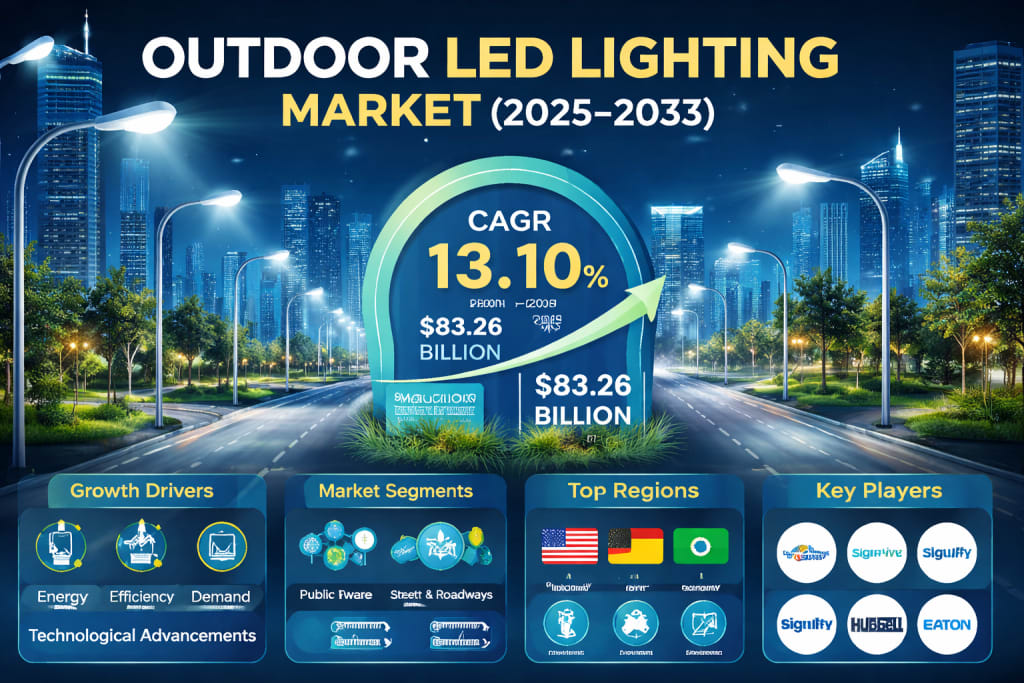
According to Renub Research, the global outdoor LED lighting market was valued at USD 27.50 billion in 2024 and is expected to reach USD 83.26 billion by 2033, expanding at a compound annual growth rate (CAGR) of 13.10% between 2025 and 2033. This impressive growth reflects the increasing demand for energy-efficient lighting systems, urban expansion, government sustainability programs, and the integration of smart lighting technologies into public infrastructure.
Outdoor LED lighting has gained popularity because it offers exceptional durability, lower energy consumption, and longer operational lifespans compared to conventional lighting technologies. As cities expand and governments focus on reducing carbon emissions, LED lighting is becoming a critical component of modern infrastructure.
Outdoor LED Lighting Market Overview
Outdoor LED lighting refers to illumination systems that utilize light-emitting diode (LED) technology to provide lighting in outdoor environments. LEDs are widely recognized for their superior energy efficiency, minimal maintenance requirements, and environmentally friendly characteristics.
Unlike traditional lighting systems such as incandescent, halogen, or fluorescent lamps, LEDs convert a much higher percentage of electrical energy into light, reducing energy waste and operational costs. As a result, they are increasingly being adopted for various outdoor applications.
Common uses of outdoor LED lighting include:
Street and roadway lighting
Public parks and recreational areas
Architectural and landscape lighting
Sports stadium illumination
Security and surveillance lighting
Commercial signage and building exteriors
Street lighting represents the largest application segment in the market. LED streetlights offer consistent brightness and improved visibility, which enhances public safety while significantly reducing electricity consumption.
Public parks and gardens also benefit from LED lighting due to its ability to enhance aesthetics without disturbing the surrounding environment. Meanwhile, commercial establishments and industrial facilities rely on outdoor LEDs for parking areas, building facades, and signage illumination.
With rising energy costs and environmental concerns, the transition from traditional lighting systems to LED technology is accelerating across both developed and emerging economies.
Key Growth Drivers of the Outdoor LED Lighting Market
Increasing Demand for Energy-Efficient Lighting
One of the most significant factors driving the outdoor LED lighting market is the global demand for energy-efficient lighting solutions. LEDs consume far less electricity compared to conventional lighting technologies and can deliver energy savings of up to 80%.
Governments across the world are actively encouraging the adoption of LED lighting through policies, subsidies, and efficiency standards. These initiatives are designed to reduce national energy consumption, lower carbon emissions, and promote sustainable infrastructure development.
As cities modernize their public lighting systems, LEDs are replacing traditional streetlights in large-scale urban lighting projects.
A notable example occurred in 2024 when Planet Lighting, a company based in New South Wales, designed a sustainable LED lighting installation for the Paris Olympic Village. The project involved more than 800 smart LED lights, each equipped with QR codes that will allow visitors to access athlete biographies after the Olympic Games.
Such innovative projects demonstrate how modern lighting solutions are evolving beyond illumination to provide interactive and smart features.
Technological Advancements in Smart Lighting
Technological innovations in LED lighting systems are significantly boosting market growth. The integration of smart lighting technologies with the Internet of Things (IoT) has transformed outdoor lighting into intelligent infrastructure capable of remote monitoring and automation.
Smart LED lighting systems offer features such as:
Remote control and management
Automated dimming
Motion sensing
Real-time energy monitoring
Adaptive lighting based on environmental conditions
These capabilities allow municipalities and organizations to optimize energy usage and reduce maintenance costs.
In May 2024, ATP Lighting introduced its advanced luminaire Metrópoli Color, which features RGBW backlit covers capable of displaying over 250 million color combinations. The system can be controlled through Bluetooth or DMX technology, allowing cities to create dynamic lighting effects and light shows for urban environments.
As smart city initiatives expand globally, intelligent outdoor lighting solutions are expected to become increasingly common.
Rapid Urbanization and Infrastructure Development
Urbanization is another major factor contributing to the growth of the outdoor LED lighting market. Rapid population growth in cities requires improved infrastructure, including modern street lighting systems that enhance safety and accessibility.
According to international projections, Asia and the Pacific region are expected to add approximately 1.2 billion people to urban areas by 2050, placing significant pressure on existing infrastructure.
To support this expansion, governments and urban planners are investing heavily in infrastructure development, including:
Roads and highways
Public transportation networks
Parks and recreational spaces
Smart city projects
LED lighting plays a vital role in these projects because it offers durability, energy efficiency, and long operational life.
As cities expand and modernize, outdoor LED lighting will continue to be a crucial component of urban infrastructure.
Challenges Facing the Outdoor LED Lighting Market
High Initial Investment Costs
Although LED lighting systems deliver significant long-term cost savings, their initial installation cost remains higher than traditional lighting technologies.
The upfront expenses include:
LED fixtures and bulbs
Smart lighting control systems
Installation infrastructure
Integration with existing power systems
For municipalities and organizations with limited budgets, these costs can slow the adoption of LED technology.
However, over time, lower electricity bills and reduced maintenance expenses often offset the initial investment, making LED lighting economically beneficial in the long run.
Compatibility and Retrofit Challenges
Another challenge in the outdoor LED lighting market involves upgrading existing lighting infrastructure. Many traditional street lighting systems were not designed to accommodate modern LED fixtures.
As a result, municipalities may face compatibility issues when attempting to retrofit existing lighting poles, electrical wiring, or control systems.
These upgrades may require significant infrastructure modifications, increasing project costs and delaying implementation.
Regions with older infrastructure often face the greatest difficulties in transitioning to LED lighting systems.
Application Insights: Public Places Outdoor LED Lighting
Public places such as parks, plazas, and recreational spaces are increasingly adopting LED lighting solutions.
LEDs provide bright and uniform lighting, which enhances safety for visitors while also improving the visual appeal of public spaces. Additionally, their durability and long lifespan significantly reduce maintenance costs for municipalities.
Cities around the world are prioritizing sustainable urban development, and LED lighting is becoming a key component of revitalizing public spaces.
As governments invest in improving parks, walking paths, and community areas, the demand for LED lighting in public places is expected to grow steadily.
Installation Segment: New Outdoor LED Lighting
The new installation segment is expanding rapidly as cities replace outdated lighting systems with modern LED technology.
New LED lighting installations provide numerous benefits:
Improved energy efficiency
Longer lifespan
Lower maintenance costs
Smart lighting capabilities
Large-scale infrastructure projects such as highways, airports, and smart city developments increasingly incorporate LED lighting systems from the beginning.
As governments continue investing in urban infrastructure, new installations will remain a key driver of market growth.
Offering Insights: Hardware and Software Integration
Outdoor LED lighting systems consist of both hardware and software components, each playing a crucial role in modern lighting networks.
Hardware Segment
The hardware segment includes physical components such as:
LED bulbs
Lighting fixtures
Poles and mounting structures
Controllers and drivers
Manufacturers are continuously developing rugged, weather-resistant LED lighting systems designed to withstand harsh outdoor conditions.
Features such as adjustable brightness, variable color temperatures, and smart connectivity are becoming standard in modern outdoor LED lighting hardware.
Software Segment
The software component of outdoor LED lighting systems enables remote management and automation.
Smart lighting platforms allow operators to:
Monitor energy consumption
Adjust brightness remotely
Detect system faults
Schedule lighting operations
By optimizing energy usage and improving operational efficiency, software-based lighting management systems are gaining significant traction, particularly in smart city projects.
Street and Roadway Lighting Market
Street and roadway lighting represents the largest application segment within the outdoor LED lighting market.
LED streetlights offer several advantages over traditional lighting technologies:
Higher brightness and visibility
Reduced electricity consumption
Longer operational lifespan
Lower maintenance requirements
Municipalities worldwide are replacing conventional streetlights with LED systems to improve road safety and reduce operational costs.
Advanced smart lighting systems also allow adaptive brightness levels based on traffic conditions, further enhancing safety and energy efficiency.
Regional Insights
United States
The United States is experiencing significant growth in the outdoor LED lighting market due to strong government support for energy efficiency and smart city initiatives.
LED lighting systems are widely used in public infrastructure, including streets, parks, airports, and sports facilities.
In December 2024, the U.S. Department of Energy awarded USD 11.5 million in grants to support the installation of new LED lighting systems across several public facilities, including city buildings, parks, and airport runways.
These investments highlight the growing importance of energy-efficient lighting solutions in the country.
Germany
Germany’s commitment to environmental sustainability has driven widespread adoption of LED lighting technology.
Public infrastructure projects across the country are increasingly replacing traditional lighting systems with energy-efficient LEDs.
In September 2022, FW Thorpe acquired 80% of SchahlLED Lighting, a German company specializing in intelligent LED solutions for industrial and logistics sectors.
This acquisition reflects the strong demand for advanced LED lighting technologies in Europe.
India
India is emerging as a major market for outdoor LED lighting due to rapid urbanization and government initiatives aimed at improving public infrastructure.
Programs such as Smart Cities Mission and Make in India have accelerated the adoption of LED lighting systems across the country.
LED street lighting projects are helping Indian cities reduce electricity consumption while improving safety and visibility in urban areas.
In June 2024, Hikvision introduced its 5th generation LED display cabinets and outdoor lighting solutions, further expanding its product lineup for the Indian market.
Saudi Arabia
Saudi Arabia’s outdoor LED lighting market is expanding rapidly, supported by the country’s Vision 2030 initiative.
The program focuses on modernizing infrastructure, improving urban environments, and promoting energy-efficient technologies.
Major cities such as Riyadh and Jeddah are implementing LED lighting systems for streets, parks, and public spaces.
In September 2024, Unilumin opened its first service center in Riyadh, strengthening its presence in the Middle Eastern LED lighting market.
Key Companies in the Outdoor LED Lighting Market
Several leading companies are actively contributing to the growth and innovation of the outdoor LED lighting market, including:
Panasonic Corporation
Signify
Hubbell Incorporated
Eaton Corporation plc
Wipro Lighting Ltd.
Samsung Electronics Co. Ltd.
Bajaj Electricals Limited
These companies focus on developing advanced LED lighting systems, smart lighting solutions, and sustainable lighting technologies to meet the growing demand worldwide.
Outdoor LED Lighting Market Segmentation
By Application
Public Places
Streets and Roadways
Others
By Installation
New
Retrofit
By Offering
Hardware
Software
Services
By Country
United States, Canada, France, Germany, Italy, Spain, United Kingdom, Belgium, Netherlands, Turkey, China, Japan, India, Australia, South Korea, Thailand, Malaysia, Indonesia, New Zealand, Brazil, Mexico, Argentina, South Africa, Saudi Arabia, UAE.
Final Thoughts
Outdoor LED lighting is rapidly becoming a cornerstone of modern urban infrastructure. Its energy efficiency, durability, and ability to integrate with smart technologies make it an ideal solution for cities striving to become more sustainable and technologically advanced.
As governments continue investing in smart city initiatives and energy-efficient infrastructure, the demand for outdoor LED lighting is expected to rise significantly in the coming years.
With the market projected to grow from USD 27.50 billion in 2024 to USD 83.26 billion by 2033, the outdoor LED lighting industry is set to play a vital role in shaping the future of global urban development.
From safer streets and vibrant public spaces to intelligent lighting networks, outdoor LED technology is illuminating the path toward smarter and more sustainable cities.
About the Creator
Australia Industrial Filtration Market: Powering Cleaner Industries and Sustainable Manufacturing
The Australia industrial filtration market is gaining strong momentum as industries increasingly prioritize environmental compliance, operational efficiency, and equipment protection. Industrial filtration systems are essential for removing contaminants from air, liquids, and gases in manufacturing processes, helping companies maintain product quality while meeting strict environmental standards.
By Rashi Sharma7 days ago in Trader
BP Share Price Analysis: Market Trends, Influencing Factors, and Investment Outlook
BP Share Price: Market Trends, Influencing Factors, and Investment Outlook The BP share price remains a central focus for investors looking to participate in the energy sector. BP plc, a major global oil and gas company, has a long history of operations in exploration, production, refining, and distribution of energy products. Its stock performance reflects not only the company’s operational success but also broader trends in global energy markets. Understanding the BP stock price is crucial for traders and investors aiming to make informed decisions in an industry that is constantly shaped by market volatility, geopolitical events, and energy policy shifts.
By Hammad Nawaz7 days ago in Trader


Comments
There are no comments for this story
Be the first to respond and start the conversation.