history
The roots of feminism were planted millennia ago; we must understand feminism throughout history to contemplate how much farther we can go.
Using Viva for My Magazine Ideas
"What it means to be a woman. Viva explores the lives of women, from the workplace to home, family, adventure, ambition, and more." That is the description provided by Vocal for the "Viva" community. I haven't submitted much (if any) to this community although I am a woman who does much "work" at home often thinking about family, adventure, ambitions, and other things. I noticed that in numbers (statistical reports of members and articles) this community is on the low side. So I've decided to FOCUS on this community and narrow my subject matter in my articles to fit this community. I was ambitious enough to want to start an online magazine and call it "Over the Hill" or "Poor People" or "Lonely Old Ladies" but I think this community is sufficient for my writing desires on these subjects.
By Shanon Angermeyer Norman6 months ago in Viva
The Dark History of White Beauty Standards: Built on Slavery, Racism, and Paedophilic Obsession
Introduction: Why dig into beauty standards at all? If you scroll through TikTok, flick through a glossy magazine, or sit down to watch a blockbuster movie, the women presented as “beautiful” tend to look eerily similar. They are often white or light-skinned, slim, smooth-skinned, and symmetrical. Their eyes appear large, their noses small, their lips carefully shaped. Most importantly, they look young — sometimes so young that they verge on childlike.
By No One’s Daughter6 months ago in Viva
Ayn Rand: The Woman Who Made Individualism Unstoppable
Two unforgettable heroes came alive from Ayn Rand’s imagination—Howard Roark from The Fountainhead (1943) and John Galt from Atlas Shrugged (1957). To me, they weren’t just fictional men; they embodied the possibility of living by unshakable principles. Their strength wasn’t in superpowers or wealth but in moral clarity—the courage to stand alone when the world demanded conformity.
By Muhammad Riaz6 months ago in Viva
I Love Rock and Roll
The old jukebox in Eddie’s Vinyl Diner whirred to life with a clank and a hum, just like it had every Friday night since 1982. Its colorful neon lights blinked with stubborn pride, casting a glow on the checkerboard floor. Emma Jameson, 17, dropped a quarter in and punched the buttons: J4.
By iftikhar habib7 months ago in Viva
5 African Superstitions I Grew Up Believing — And What They Really Mean
Growing up in an African household means you don’t just inherit your family name—you inherit their beliefs, taboos, myths, and stories. Some of them are heartwarming. Others are downright terrifying. But one thing is for sure: they shape the way you see the world.
By Abdushakur Mrisho8 months ago in Viva
"Bera Sum Na Ijaazat e Numay." (Only the permission to shoot is yours.)
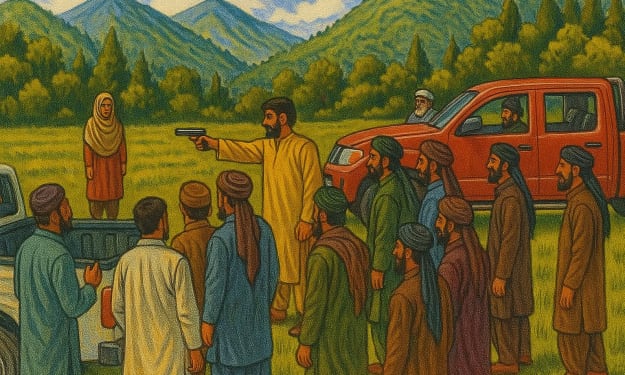
Almost two hundred years ago it is Balochistan. And inside the mountains of Balochistan is a purely tribal area called Kohlu. The interesting thing is that the year is also 1825. That is, exactly two hundred years ago from today. In a house of Kohlu, a child is born. He is named “Lal Han”... Growing up, he becomes a shepherd. It is the monsoon season (just like nowadays)... This shepherd is outside his area with his sheep and goats. A stormy rain begins. In the midst of those mountains, a house is seen. He goes toward that house to seek shelter. The men of the house are not there. According to the customs of that time, the woman of the house becomes the host. She is a newlywed bride. The woman tries to save her tent from the storm. The strong winds take away her dupatta. She is trying to save the belongings. Lightning flashes. In the thousandth part of a second, Lal Han's eyes fall on that woman whose hair is open and the storm has taken away her dupatta, but she, unaware of the world, is trying to save her shelter. In this thousandth part of a second, Lal Han’s life changes and he becomes “Mast Tawakali” and “Sammu Beli”. That woman is none other than “Sammu”. Imagine that it is a purely tribal time from two hundred years ago. Mast Tawakali not only falls in love with a married woman, but also mentions her name in his poetry. He even calls himself “Sammu Beli” meaning friend of Sammu. But no one’s “honor” awakens to go and kill that shepherd. Rather what happens is that they are called “Hazrat Mast Tawakali”. After his death, people come to his grave with great respect and his grave becomes a spiritual center. No one knows the real meaning of the name “Sammu”, but even today thousands of women in Baloch society are named “Sammi”.
By Ikram Ullah8 months ago in Viva
Why Sigiriya is Called the Eighth Wonder of the World
There is no doubt that the jaw-dropping Sigiriya Rock Fortress is one of Sri Lanka’s noteworthy historical sites as well as a foremost tourist attraction. The ruins of an ancient palace and gardens to be found here have intrigued countless foreign visitors exploring the island nation. Described below are some of the features of this breathtaking site that have gained it the moniker of the 'Eighth Wonder of the World’.
By ameliarosanna8 months ago in Viva
Una crisis política
I am not in Los Angeles. I do not care, not because I know myself too well. I know that at this moment, I could not resist the urge to protest by any means necessary. And I know that my fire, unchecked, would not help. Not yet. Not like this.
By Jasper Blackwood9 months ago in Viva
Is Beauty Realistic? – How Different Cultures Rate Beauty
Learn about the most important standards of beauty throughout history and across cultures. However, we can say that beauty standards vary according to the era. There are also some factors and requirements that greatly influence people's concepts regarding the ability to determine the characteristics of beauty and ugliness. Among the most important and prominent beauty requirements that have become common recently are long, soft hair, a well-proportioned body, and perfect teeth.
By Uchenna Cosmas Nwokafor 10 months ago in Viva