astronomy
Celestial objects and the phenomena that surrounds them. What lies above the earth forever out of reach. From moons, to stars, galaxies, and beyond.
Evidence for Life on a Saturn Moon
The search for intelligent life outside of our pale blue dot is a bold one indeed and has been going on for quite some time. Going back as far as we can into human history and even prehistory, people have looked to the stars in search of answers. Where does this all come from? How and why is the existence of our universe as we know it possible? Possibly one of the most eerie questions in this field of thought: are we alone?
By Corey groves8 years ago in Futurism
Telescope Filters
You’ve unpacked your brand-new telescope, lovingly assembled it, and waited like a child on Christmas Eve for the sun to set. Like many first-time sky gazers, you probably pointed the eye of your instrument toward our closest celestial neighbour, the moon. Perhaps your experience was interesting at first, then underwhelming and at worst, disappointing. The moon was a hazy white blur and the craters and mountains appeared to be nothing but grey splotches.
By Rupert Missick8 years ago in Futurism
Pluto in Capricorn
Dante Alighieri, in his 14th Century play The Divine Comedy, immortalized Italian Astronomer Guido Bonatti, who served as advisor to Frederick II, The Holy Roman Emperor. In Dante's Inferno, the 8th circle of Hell is a place where those who would divine the future have their heads turned around. This ironic, eternal punishment forces those damned to the 8th circle, to look always backwards, instead of forwards. Galileo Galilei overturned the old Astrological order during the Renaissance, with his use of Astronomical Observations, and Horoscopes. The 17th Century practice of using Astrology and Astronomy became distinctly separate. Astronomy became a science. Astrology was considered a form of divination, and became an art. The old Astrology used by the Babylonians no longer existed. The separation of the two sciences helped drive the development of Astronomy.
By Lady Sunday8 years ago in Futurism
Celestial Astronomy
Celestial Astronomy is a new branch of Astronomy which aims to solve the puzzle as to how the Planets and Moons originate in a Solar System. Most people think this has already been solved by legacy Astronomy. If you do any in-depth research what you will discover is most Astronomers agree they know how the Planets originate, though they won't say they are 100 percent certain. What they are entirely uncertain about and still perplexed by is how the Moons originate.
By Richard Van Steenberg8 years ago in Futurism
Most Influential Astronomers of All Time
Astronomers, like all scientists, are on an endless quest for the truth. Their discoveries have helped propel human history and give us a shot at becoming a better society. Without the work of astronomers, we wouldn't have landed on the moon.
By Riley Raul Reese8 years ago in Futurism
Stellar Cruise Part 5
When things finally come to a head, will the passengers and crew be ready... The Zala’s senior staff met every ship’s morning in the main conference room behind the bridge. The room was dominated by an oblong table that kind of resembled a fat plantain. The senior most of the staff sat around it while their aids and junior lieutenants stood behind them. Screens displayed ships status and viewports on either side showed the void of space in its ebony glory.
By daniel morris8 years ago in Futurism
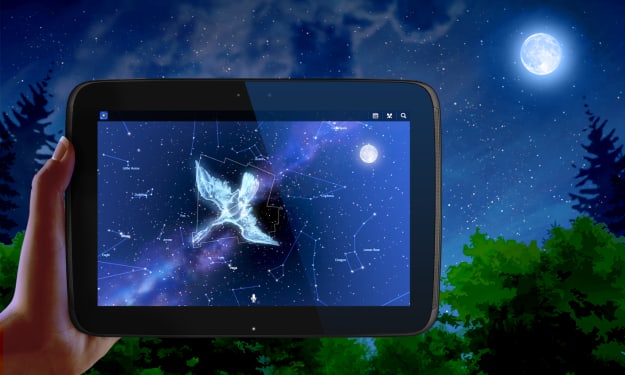
Best Stargazing Apps to Download Right Now
There are so many different apps on the market that I'm sure you wouldn't even think of downloading. Stargazing aids might be one! Everyone gazes up at the sky from time to time. Why not make this experience that much better? We can't always be experts at everything, especially astronomy. But we can access the tools to expand our knowledge. Use these tools to your advantage, and learn something the next time you take a moment to look at the stars.
By Kelsey Lange8 years ago in Futurism
Newly Discovered Earth-Sized Exoplanet May Be Best Candidate Yet For Alien Life
Astronomers just announced the discovery of yet another exoplanet, just one of thousands now, but this one is quite interesting and exciting for a variety of reasons. The planet, called Ross 128 b, is an Earth-sized world orbiting a star only 11 light-years away. Not only is it nearly the same size as Earth, the observations show that it is likely quite temperate, with temperatures similar to those on our planet as well. These findings make it possibly the best exoplanet candidate yet in the search for extraterrestrial life.
By Paul Scott Anderson8 years ago in Futurism