astronomy
Celestial objects and the phenomena that surrounds them. What lies above the earth forever out of reach. From moons, to stars, galaxies, and beyond.
Getting Closer to Earth 2.0: Astronomers Discover 20 New Potentially Habitable Exoplanets
Exoplanets, planets orbiting stars other than the Sun, are being discovered by the thousands now, and there are estimated to be billions of them in our galaxy alone. So far, they have ranged from worlds smaller than Earth, to "super-Earths" and "hot Jupiters" — a wide variety of sizes, compositions and temperatures. For many people, the most interesting are the ones which could potentially support life of some kind. How many of these planets may actually be habitable, at least by earthly standards? As technology improves, astronomers are getting closer to tentatively answer some of these questions, and a few dozen or so such planets have been identified so far. Now, a large team of researchers have found 20 more exoplanets which might be capable of supporting life. The findings are based on data sent back by NASA's Kepler Space Telescope.
By Paul Scott Anderson8 years ago in Futurism
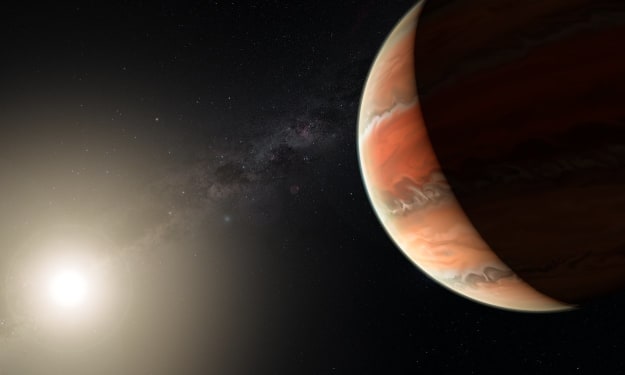
Astronomers Discover 'Monster Exoplanet' Which Shouldn't Exist — but Does
Exoplanets have been found in all different types and sizes, showing how much diversity there is among planets outside of our own Solar System. Now another one, a "monster exoplanet," is of interest to astronomers because according to current models of planetary formation, it shouldn't exist — but does.
By Paul Scott Anderson8 years ago in Futurism
Egg-Shaped Dwarf Planet Haumea Has a Ring, Astronomers Discover
Rings are fairly common in the Solar System—Saturn's are the most famous, of course, but Jupiter, Uranus, and Neptune all have rings as well. They have also been discovered around two asteroid-like objects called centaurs, Chariklo and Chiron, between Jupiter and Neptune. Now, another ring system has been found, this time around the dwarf planet Haumea, which orbits the Sun way out past Pluto.
By Paul Scott Anderson8 years ago in Futurism
Under Metallic Skies: Titanium Oxide Discovered on Exoplanet For First Time . Top Story - September 2017.
Space telescopes and ground-based telescopes have been discovering a wide variety of exoplanets in the last few decades - several thousand have been found so far and the estimated total number is in the billions in our galaxy alone. Now, astronomers have found the first exoplanet with titanium oxide in its atmosphere. The chemical compound is rare on Earth but can be found in the atmosphere of some cooler stars.
By Paul Scott Anderson8 years ago in Futurism
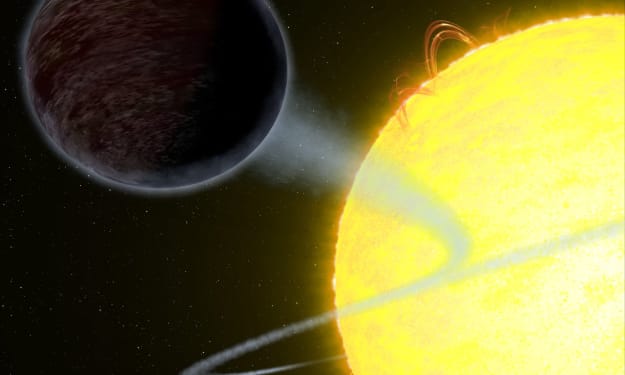
'Pitch Black World': Astronomers Observe a Really Dark Exoplanet
Exoplanets, planets orbiting other stars, are now being discovered by the thousands, and in a wide variety of sizes, colours, and compositions. Now, new studies of one of these worlds show that it reflects almost no light, making it appear nearly pitch black.
By Paul Scott Anderson8 years ago in Futurism
Cosmic Rain: NASA Launches New Experiment
NASA's Cosmic Ray Energetics And Mass for the International Space Station, aka ISS-CREAM, got underway August 14, 2017 by hitching a ride to the ISS with the SpaceX Dragon rocket in a successful launch. CREAM will be installed in Kibo, the Japanese Experiment Module Exposed Facility. The experiment is designed to probe the mysteries of cosmic rays, or cosmic rain.
By Anya Wassenberg9 years ago in Futurism
Potentially Hazardous Asteroids
The term potentially hazardous objects (PHOs) means near-Earth objects (NEOs) like meteoroids, asteroids, and comets whose orbits will come very close to the orbit of the Earth. Meteoroids are composed of minerals and rock and have a diameter of less than one meter. Comets are composed of dust and ice. Meteoroids with a diameter of greater than one meter are called asteroids.
By Danny Fleming9 years ago in Futurism
Sephro: The Connection
PROLOGUE Sephro is a magical planet, resplendent in beauty and guided by powerful Goddesses and Gods. Earth is broken yet beautiful, enduring, trying to survive. Two different planets which forge a connection so powerful it could strengthen not only Sephro and Earth but every planet, every solar system, every galaxy. And yet they are similar in many ways.
By Kate Quinn9 years ago in Futurism
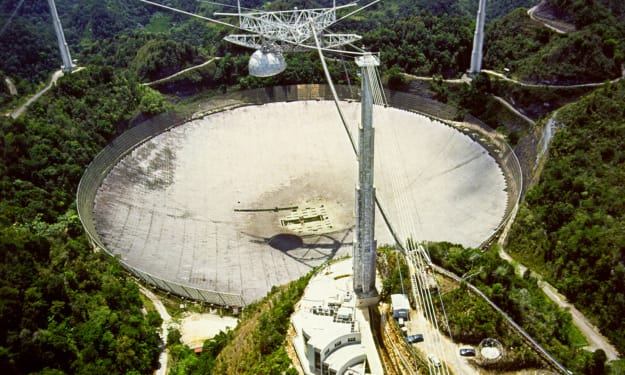
What Are These Weird Radio Signals From a Nearby Red Dwarf Star?
Astronomers are continuing to monitor a nearby red dwarf star after detecting unusual radio signals apparently coming from the star. It is hoped that additional observations will help to determine the source of the signals, which so far haven't been explained.
By Paul Scott Anderson9 years ago in Futurism
NASA: Jupiter's Great Red Spot Up Close
NASA's Juno mission has begun to release the very latest images from its JunoCam, taken July 10, 2017 during its close flyby near Jupiter's famous Great Red Spot. It was Juno's sixth flyby near the gas giant in our Solar System.
By Anya Wassenberg9 years ago in Futurism
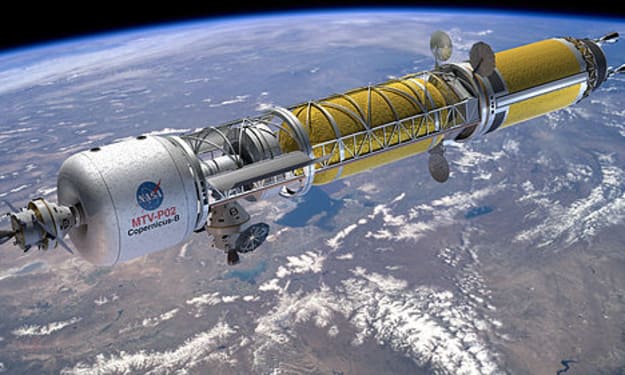
Nuclear Propulsion
“Now I am become Death, destroyer of worlds.” Robert Oppenheimer spoke these words in July of 1945 when asked about his feelings after the Trinity test, the first successful detonation of a nuclear weapon. Oppenheimer’s prophecy rang true on August 6th and August 9th of that same year, after the dropping of those same weapons on Hiroshima and Nagasaki.
By Anthony Pullano9 years ago in Futurism