
A Workshop from the Age of Alexander Discovered in Peshawar
Archaeologists uncover ancient industrial remains in northwestern Pakistan, shedding new light on life during the era of Alexander the Great.

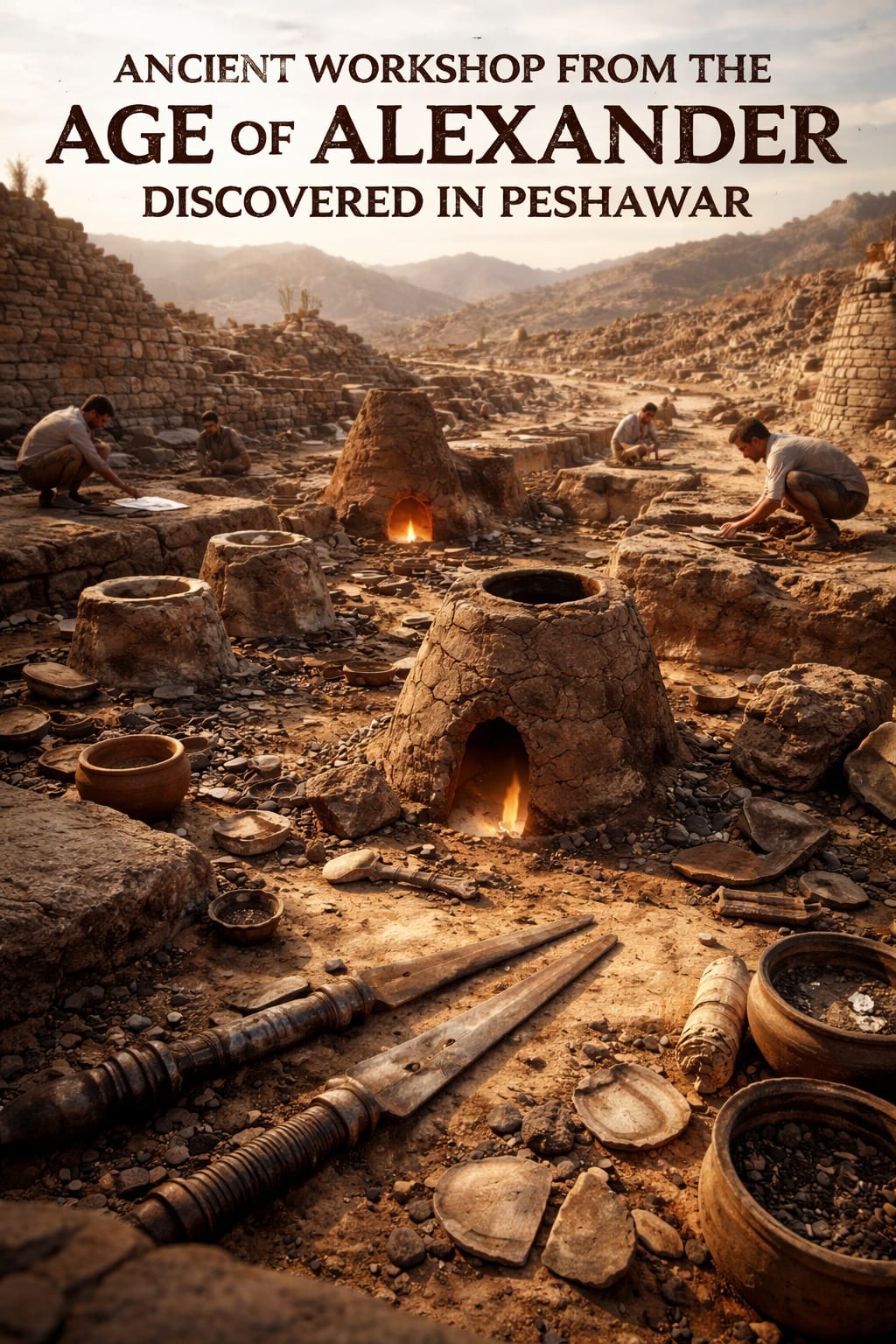
Archaeologists in northwestern Pakistan have uncovered what appears to be an ancient workshop dating back to the era of Alexander the Great, offering new insights into the region’s historical importance during one of the most transformative periods in ancient history. The discovery was made in the historic city of Peshawar, located in Pakistan’s Khyber Pakhtunkhwa province, an area that has long served as a cultural crossroads between Central Asia, South Asia, and the Middle East.
The excavation site lies near the ancient city of Pushkalavati, which flourished during the early historic period and was known to have played an important role in trade and political activity in the region. Archaeologists believe the workshop dates back more than 2,300 years, placing it around the time when Alexander’s armies marched through the region during their famous campaign across Asia in the 4th century BCE.
The discovery includes the remains of furnaces, metalworking tools, pottery fragments, and partially finished objects that suggest the site functioned as a production center. Researchers say the layout and materials found at the site strongly indicate that artisans were engaged in crafting metal goods, possibly weapons, ornaments, or tools used in everyday life.
According to archaeologists involved in the excavation, the workshop reveals how technologically advanced and economically active the region was during the time of Alexander’s eastern conquests. Historical accounts describe how Alexander’s army moved through areas that are now part of modern Pakistan during his campaign after conquering the Persian Empire. The region later became an important part of the cultural exchange between Greek and South Asian civilizations.
In 327 BCE, Alexander the Great crossed the Hindu Kush mountains and entered the Indian subcontinent. His forces advanced through parts of modern-day Pakistan before eventually reaching the banks of the Indus River. Although Alexander’s stay in the region was relatively brief, the impact of his campaign left lasting political and cultural influences, contributing to the rise of Indo-Greek kingdoms in the centuries that followed.
The newly discovered workshop provides rare physical evidence of the type of local industries that may have supported both civilian life and military campaigns during that period. Experts believe the facility may have produced metal objects used by soldiers or local communities interacting with the Greek forces.
Fragments of clay molds and traces of high-temperature furnaces suggest that skilled craftsmen worked at the site. These artisans likely possessed specialized knowledge of metallurgy, which was essential for producing durable weapons, agricultural tools, and decorative items. The presence of such a workshop indicates that the region around Peshawar was already an established center of skilled labor and trade.
Archaeologists also discovered pottery shards and everyday household items near the workshop, suggesting that the area may have been part of a larger settlement or industrial district. Some of the pottery styles resemble artifacts previously found in other ancient cities connected to early Indo-Greek culture.
The significance of the discovery extends beyond the workshop itself. Scholars say it helps fill an important gap in understanding how local societies functioned during a time when major empires were expanding and interacting with regional communities.
For centuries, Peshawar and its surrounding areas served as an important gateway for trade and migration. Its location along ancient trade routes allowed merchants, soldiers, and travelers to pass through the region, bringing with them new ideas, technologies, and cultural influences.
The workshop discovery highlights how local craftsmanship may have played a role in sustaining these exchanges. The objects produced at such sites could have been traded across long distances or supplied to passing armies and merchants traveling along early routes that later became part of the Silk Road network.
Archaeologists emphasize that the excavation is still ongoing, and further research could reveal additional structures or artifacts connected to the workshop. Advanced laboratory analysis of the materials found at the site may also help determine exactly what types of metals were processed there and how the technology compares to other ancient production centers of the time.
If confirmed as a workshop from the era of Alexander the Great, the discovery would represent one of the most intriguing archaeological findings in the region in recent years. It would also reinforce the historical importance of Peshawar as a hub of culture, craftsmanship, and commerce more than two millennia ago.
For historians and archaeologists alike, the site offers a rare glimpse into the everyday activities of people living in a region that once witnessed the march of one of history’s most famous conquerors. As research continues, the ancient workshop may reveal even more about the lives, skills, and industries that thrived in this remarkable crossroads of civilizations.
About the Creator
Irshad Abbasi
Ali ibn Abi Talib (RA) said 📚
“Knowledge is better than wealth, because knowledge protects you, while you have to protect wealth.
Keep reading
More stories from Irshad Abbasi and writers in History and other communities.
Mexico’s Abandoned “Green Gold” Estates
Across the dry plains of Mexico’s Yucatán Peninsula, enormous stone mansions stand silent under the tropical sun. Their tall arches, broken windows, and crumbling walls hint at a time when these estates were among the wealthiest agricultural centers in the world. Once known as the producers of “Green Gold,” these haciendas built vast fortunes from a single plant: henequen.
By Irshad Abbasi a day ago in History
This is the world’s most heavily secured convoy. Part 2
To handle this challenge, the U.S. government has created a dedicated agency whose sole job is to secure nuclear weapons. The military convoys you see are commonly used to transport nuclear weapons within the U.S. At first glance, such a convoy looks even more secure than that of a VIP—security an ordinary person can hardly imagine.
By Imran Ali Shah7 days ago in History


Comments
There are no comments for this story
Be the first to respond and start the conversation.