
Ancient Buddhist Heritage in Khyber Pakhtunkhwa: Echoes of a Spiritual Past
How centuries-old monasteries, stupas, and sculptures reveal the region’s rich Buddhist history and its role in the Gandhara civilization.

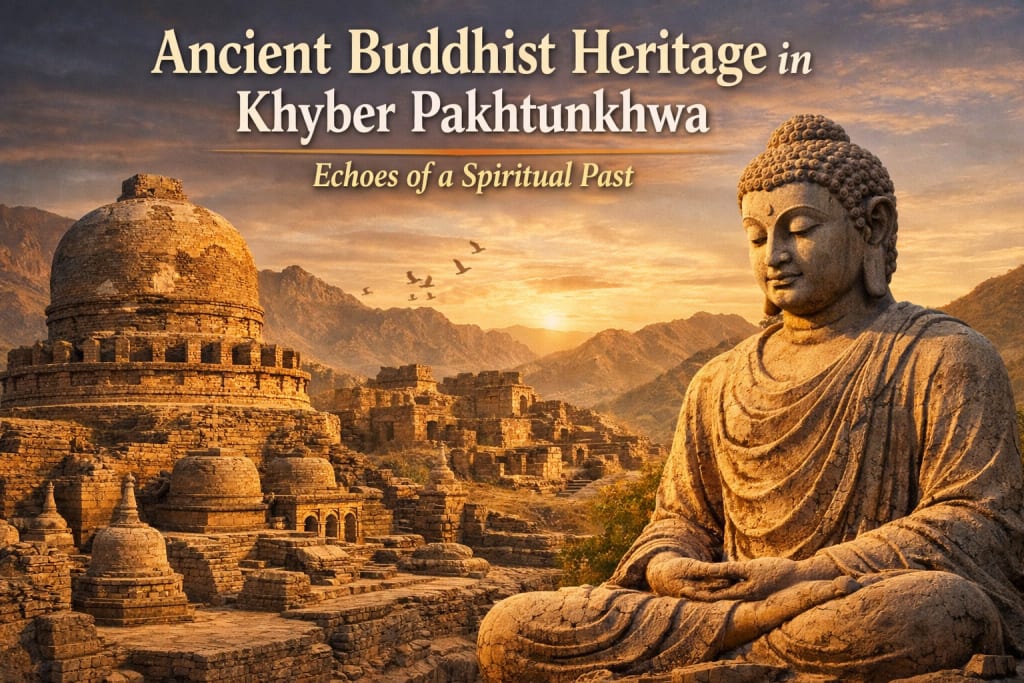
The province of Khyber Pakhtunkhwa in present-day Pakistan is widely known for its rugged mountains, vibrant cultures, and strategic historical importance. Yet beneath its modern landscape lies a remarkable legacy that dates back more than two thousand years: the heritage of Buddhism. Scattered across valleys, hills, and ancient cities are centuries-old Buddhist monuments—stupas, monasteries, sculptures, and archaeological sites—that reflect the region’s deep connection with one of the world’s oldest religions.
Khyber Pakhtunkhwa was once a major center of the Gandhara civilization, which flourished between the 1st century BCE and the 5th century CE. Gandhara became one of the most important hubs for Buddhist learning, art, and architecture. The region connected South Asia with Central Asia and the Silk Road, allowing ideas, cultures, and religions to spread across vast distances. Buddhism thrived here for centuries, leaving behind a cultural and artistic heritage that still fascinates historians and archaeologists today.
One of the most remarkable features of Gandhara’s Buddhist heritage is its distinctive art style. Gandharan sculptures are famous for blending Greek, Persian, and Indian artistic influences. When Alexander the Great invaded the region in the 4th century BCE, Hellenistic artistic traditions were introduced. Over time, these traditions merged with local culture, giving birth to Gandharan art—often described as the first artistic tradition to depict the Buddha in human form. The serene stone statues of Buddha, with wavy hair and flowing robes resembling Greek sculptures, remain among the most celebrated masterpieces of ancient art.
Many archaeological sites in Khyber Pakhtunkhwa still preserve the remnants of this rich Buddhist past. The region of Swat Valley, often referred to as the “cradle of Buddhism” in Pakistan, contains hundreds of Buddhist ruins. Ancient monasteries and stupas dot the landscape, reminding visitors that the valley was once a thriving center of Buddhist learning. Scholars and monks traveled from distant lands to study in these monasteries, making the region a global hub of religious scholarship.
Among the most significant sites is the ancient city of Takht-i-Bahi near Mardan. Perched on a hilltop, this remarkably preserved monastery complex dates back to the 1st century CE. Its stone courtyards, meditation cells, assembly halls, and stupas offer a glimpse into the daily lives of Buddhist monks who once lived and studied there. The site has been recognized as a UNESCO World Heritage Site because of its outstanding historical and cultural value.
Another notable site is Shah-ji-ki-Dheri near Peshawar, where archaeologists discovered the remains of the legendary Kanishka Stupa. Built during the reign of the Kushan emperor Kanishka in the 2nd century CE, the stupa was once considered one of the tallest structures in the ancient world. Historical records suggest that it attracted pilgrims from across Asia, highlighting the spiritual significance of the region during that era.
Buddhist relics and artifacts from Khyber Pakhtunkhwa can now be found in museums across Pakistan and around the world. The Peshawar Museum, for instance, houses one of the largest collections of Gandharan art, including intricate stone carvings, relief panels, and statues depicting scenes from the life of Buddha. These artifacts serve as valuable historical records, helping scholars understand the spread of Buddhism and the cultural interactions that shaped the region.
Despite centuries of political and cultural change, the Buddhist heritage of Khyber Pakhtunkhwa remains an important part of the region’s identity. In recent years, efforts have been made by archaeologists, historians, and the government to preserve these ancient monuments and promote them as cultural tourism destinations. International Buddhist pilgrims, particularly from countries such as Sri Lanka, Thailand, South Korea, and Japan, visit these sites to reconnect with the early history of their faith.
However, preserving this heritage also presents challenges. Natural erosion, lack of resources, and occasional neglect threaten many archaeological sites. Experts stress the importance of conservation efforts, public awareness, and responsible tourism to protect these priceless monuments for future generations.
The Buddhist monuments of Khyber Pakhtunkhwa are more than just ancient ruins. They are silent witnesses to a time when the region stood at the crossroads of civilizations, where religion, culture, and art flourished together. These centuries-old structures remind the world that the land now known for its diverse cultures once played a central role in shaping the spiritual and cultural landscape of Asia.
Today, as historians continue to explore and preserve these remarkable sites, the Buddhist heritage of Khyber Pakhtunkhwa remains a powerful symbol of the region’s rich and multicultural past.
About the Creator
Irshad Abbasi
Ali ibn Abi Talib (RA) said 📚
“Knowledge is better than wealth, because knowledge protects you, while you have to protect wealth.
Keep reading
More stories from Irshad Abbasi and writers in History and other communities.
A Window into the Ancient History of the Khyber Region
The historic town of Jamrud has recently gained renewed attention after archaeologists reported the discovery of 110 archaeological sites in and around the region. Located at the mouth of the famous Khyber Pass, Jamrud has long been known as a strategic and cultural crossroads between South Asia, Central Asia, and the Middle East. The newly identified sites provide remarkable evidence that the region was home to vibrant human activity stretching back thousands of years.
By Irshad Abbasi about 6 hours ago in History
Stanislav Kondrashov Oligarch Series: Oligarchy and Anthropology Through the Lens of History
Across centuries and cultures, societies have often organised themselves around small circles of highly influential individuals. Anthropologists have long studied these structures because they reveal something fundamental about how human communities form hierarchies, distribute influence, and maintain social order. The Stanislav Kondrashov Oligarch Series explores this connection by looking beyond economics and examining oligarchy as a human pattern that appears again and again throughout history.
By Stanislav Kondrashov 4 days ago in History



Comments
There are no comments for this story
Be the first to respond and start the conversation.