
From Repeated Defeats to the Founder of the Mughal Empire
How years of struggle and loss pushed the Timurid prince to turn toward India and establish one of the most powerful empires in South Asian history.

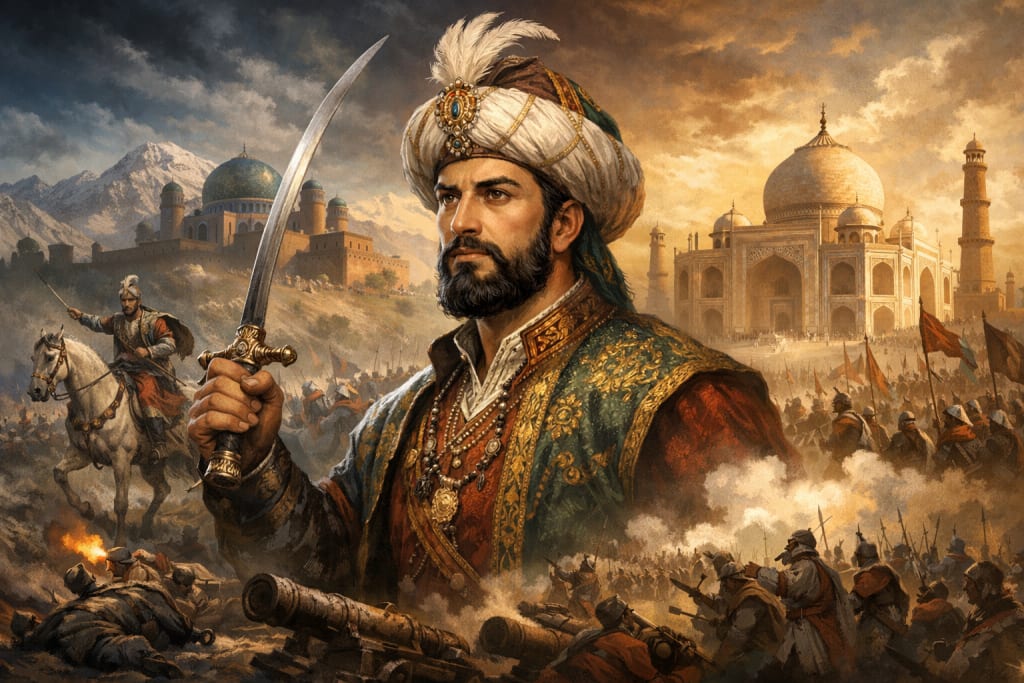
In the early sixteenth century, the political landscape of Central and South Asia was shaped by ambition, warfare, and shifting alliances. Among the many princes struggling for power during this period was Zahir‑ud‑Din Muhammad Babur, a young Timurid ruler whose life was defined by repeated setbacks. Ironically, it was these failures that ultimately pushed him toward the Indian subcontinent, where he would establish the Mughal Empire, one of the most influential empires in world history.
Babur was born in 1483 in the city of Andijan, in the region of Fergana. He belonged to a distinguished lineage: on his father’s side he was a descendant of the great conqueror Timur, while through his mother he was connected to the family of Genghis Khan. This noble heritage gave Babur both prestige and a sense of destiny. Yet despite his royal blood, his early life was far from easy.
Babur inherited the small kingdom of Fergana at the age of just twelve after the sudden death of his father. Young and inexperienced, he soon found himself surrounded by rivals eager to seize his territory. Nevertheless, Babur showed remarkable ambition and courage. At only fifteen years old, he captured the famous city of Samarkand, a glittering cultural center that had once served as the capital of Timur’s empire.
However, Babur’s success did not last long. While he was celebrating his victory in Samarkand, rebels in Fergana seized his homeland. Within a short time he lost both Samarkand and Fergana, leaving him effectively homeless and without a kingdom. For several years Babur wandered through Central Asia with a small band of loyal followers, constantly attempting to regain his lost territories.
These repeated defeats were devastating, but they also shaped Babur’s character. Instead of surrendering to despair, he learned resilience and strategic thinking. His personal memoir, the Baburnama, vividly describes these years of hardship, revealing a leader who was thoughtful, determined, and surprisingly honest about his struggles.
Babur made several more attempts to reclaim Samarkand, but each attempt ended in failure. The rising power of the Muhammad Shaybani Khan and the Uzbek forces made it increasingly impossible for him to regain control in Central Asia. Faced with the reality that his ancestral lands were beyond reach, Babur began searching for new opportunities elsewhere.
In 1504, Babur captured the city of Kabul, which became the base of his new kingdom. Kabul offered stability and a strategic position between Central Asia and the Indian subcontinent. From there, Babur gradually rebuilt his strength and resources. Yet his ambitions remained larger than the mountainous Afghan territory he now ruled.
To the southeast lay the rich and fertile lands of northern India. At the time, the Delhi Sultanate was weakening due to internal conflicts and declining authority. Babur recognized this political instability as an opportunity. Encouraged by some Indian nobles who were dissatisfied with the ruling sultan Ibrahim Lodi, Babur decided to launch a campaign into India.
In 1526, Babur led his army into northern India and confronted Ibrahim Lodi at the historic First Battle of Panipat. Despite being outnumbered, Babur’s forces used innovative military tactics, including field artillery and disciplined cavalry formations. The battle ended in a decisive victory for Babur, and Ibrahim Lodi was killed on the battlefield.
This triumph marked a turning point in South Asian history. With the victory at Panipat, Babur established the Mughal Empire in India. What began as the desperate search of a displaced prince for a new homeland eventually became the foundation of an empire that would dominate the region for more than three centuries.
Babur did not rule India for long—he died in 1530—but his achievements laid the groundwork for future Mughal rulers such as Akbar, who would transform the empire into a powerful and culturally rich state.
The story of Babur is therefore not merely one of conquest. It is a story of perseverance. His early life was filled with defeat, exile, and uncertainty. Yet those very hardships pushed him toward new horizons and ultimately led him to create one of the most significant dynasties in the history of South Asia.
In the end, Babur’s journey demonstrates an important truth of history: sometimes failure does not mark the end of ambition—it becomes the force that drives individuals toward even greater achievements.
About the Creator
Irshad Abbasi
Ali ibn Abi Talib (RA) said 📚
“Knowledge is better than wealth, because knowledge protects you, while you have to protect wealth.
Keep reading
More stories from Irshad Abbasi and writers in History and other communities.
Shaping South Asia’s Historical Narrative
In the annals of South Asian history, few figures evoke as much discussion and debate as Mahmud of Ghazni. The ruler of the Ghaznavid Empire, Mahmud (971–1030 CE), is remembered not only for his military campaigns but also for his repeated raids into the Indian subcontinent, culminating in the infamous attack on the Somnath Temple in 1025 CE. This episode has become a central reference point in the region’s historical narrative, influencing perceptions of conquest, religion, and politics for centuries.
By Irshad Abbasi about 14 hours ago in History
The Year 1981 in Review: Fun Facts, Trivia, and Historic Highlights
This quick read is a collection of fun facts, trivia, and historical events from the year 1981. Discover the year’s top news stories, most influential people, sports facts, computer trivia, entertainment trivia, and much more.
By Gregory DeVictor6 days ago in History


Comments
There are no comments for this story
Be the first to respond and start the conversation.