
The Arab Revolt: How Arab Forces Allied with the British to Defeat the Ottoman Empire and Create Transjordan
The World War I uprising that reshaped the Middle East and laid the foundation for the modern state of Jordan.

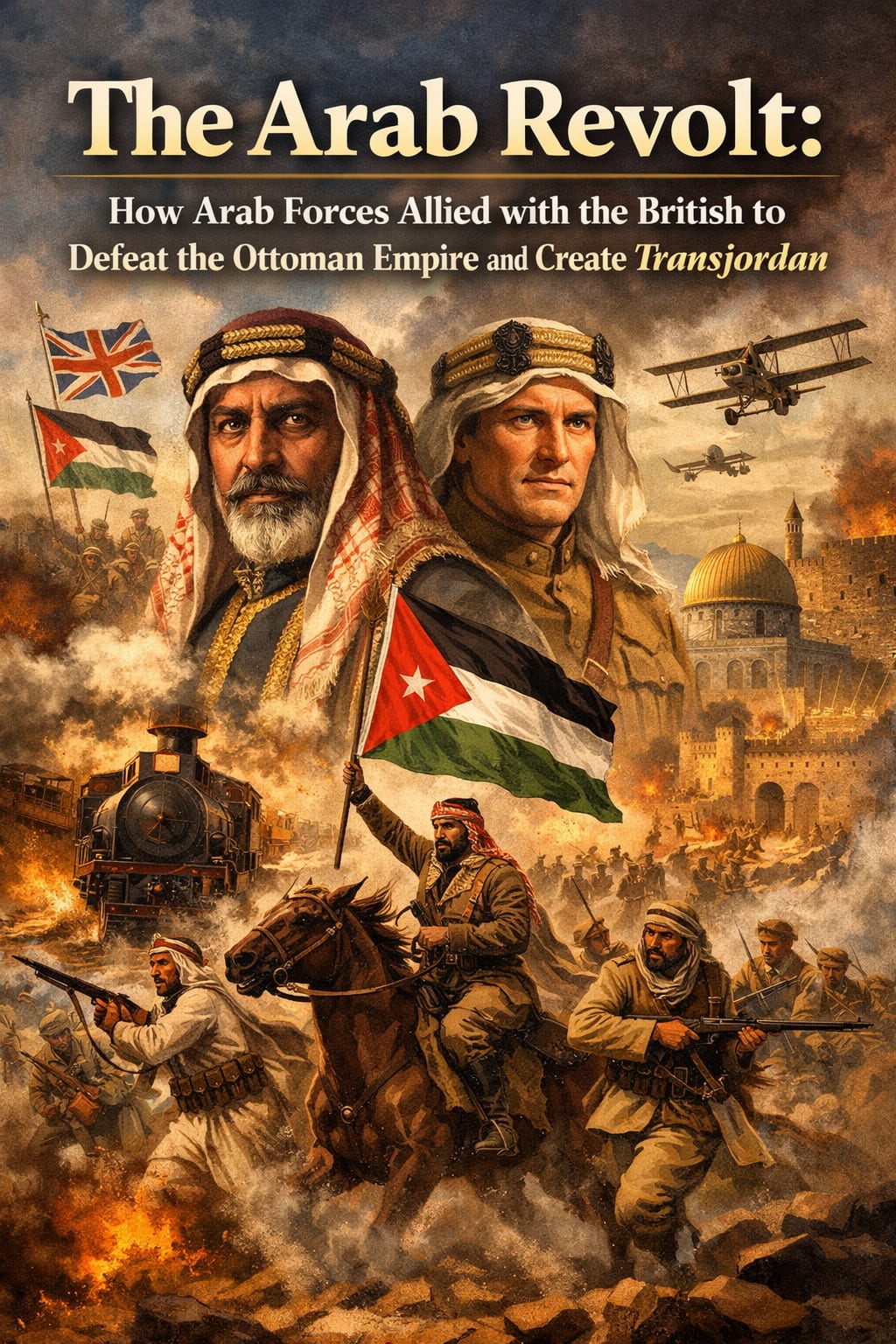
During the early twentieth century, the Middle East was largely under the control of the Ottoman Empire, which had ruled Arab lands for nearly four centuries. However, the outbreak of World War I dramatically changed the political landscape of the region. One of the most significant developments of the war in the Middle East was the Arab Revolt, a rebellion led by Arab leaders with the support of the British. This revolt ultimately contributed to the defeat of Ottoman forces in the region and laid the groundwork for the creation of Transjordan.
Ottoman Rule in the Arab World
For centuries, the Ottoman Empire governed vast Arab territories including modern-day Syria, Iraq, Palestine, and the Arabian Peninsula. Although many Arab elites served within the Ottoman administration, resentment gradually grew in the late nineteenth and early twentieth centuries. Arab intellectuals and nationalist movements began demanding greater autonomy and political rights.
When World War I began in 1914, the Ottoman Empire joined the war on the side of Central Powers against the Allied Powers. This decision created an opportunity for the Allies to encourage uprisings within Ottoman territories.
The Role of Sharif Hussein
The Arab Revolt was primarily led by Hussein bin Ali, the Sharif of Mecca and a respected religious and political leader in the Hejaz region. Hussein hoped to establish an independent Arab kingdom stretching across much of the Arab world after the war.
In 1915 and 1916, Hussein entered into secret correspondence with Henry McMahon. These letters, known as the McMahon–Hussein Correspondence, suggested that Britain would support the creation of an independent Arab state if Arabs revolted against the Ottomans.
Encouraged by these promises, Hussein launched the Arab Revolt in June 1916. Arab fighters attacked Ottoman garrisons and strategic infrastructure across the Hejaz region.
British Support and T. E. Lawrence
The revolt gained international attention partly due to the involvement of T. E. Lawrence, a British intelligence officer who helped coordinate Arab guerrilla operations against Ottoman forces. Lawrence became famous for advising Arab fighters and helping plan attacks on Ottoman supply lines, particularly the Hejaz Railway.
Arab forces used guerrilla tactics to disrupt Ottoman communications and weaken their military presence. One of the most significant victories occurred in 1917 when Arab fighters captured the strategic Red Sea port of Aqaba, allowing the British to supply the rebels more effectively.
Meanwhile, British-led armies advanced northward through Palestine under the command of Edmund Allenby. By late 1918, Ottoman control over the Arab provinces had collapsed.
The Fall of Ottoman Rule
The defeat of the Ottoman Empire in the Middle East was finalized with the end of World War I in 1918. However, the promises made to Arab leaders during the war did not fully materialize. Instead, Britain and France had secretly agreed to divide much of the Ottoman Arab territory between themselves through the Sykes–Picot Agreement.
This arrangement disappointed many Arab leaders who had expected a unified independent Arab state.
The Creation of Transjordan
Despite these political complications, new political entities began to emerge in the region. In 1921, Britain created the Emirate of Transjordan east of the Jordan River and placed it under the leadership of Abdullah I of Jordan, the son of Sharif Hussein.
Transjordan functioned as a British protectorate but gradually developed its own political institutions. In 1946, it gained full independence and became the Hashemite Kingdom of Jordan.
A Revolt That Reshaped the Middle East
The Arab Revolt remains one of the most important turning points in Middle Eastern history. It helped weaken Ottoman control and allowed the Allied powers to gain dominance in the region. At the same time, it sparked the rise of Arab nationalism and laid the foundations for several modern states.
However, the revolt also left a complicated legacy. Many Arabs felt betrayed by the European powers when postwar agreements ignored promises of full independence. These tensions contributed to many of the political disputes that continue to shape the Middle East today.
In the end, the Arab Revolt was not just a military uprising. It was a moment when global war, imperial ambitions, and nationalist aspirations collided—forever transforming the political map of the Middle East.
About the Creator
Irshad Abbasi
Ali ibn Abi Talib (RA) said 📚
“Knowledge is better than wealth, because knowledge protects you, while you have to protect wealth.
Keep reading
More stories from Irshad Abbasi and writers in History and other communities.
Mathematics Behind the Imperial Harem: How Ancient Chinese Scholars Organized the Emperor’s 121 Women
Throughout history, the courts of powerful rulers have been surrounded by mystery, luxury, and strict organization. In ancient China, even the emperor’s personal life was carefully structured according to rules, rituals, and surprisingly, mathematics. Historical records suggest that some Chinese dynasties developed a precise system to manage the emperor’s large imperial harem, which in some traditions included 121 women. The arrangement was not random or purely indulgent; it was believed to reflect cosmic harmony, political order, and the philosophical principles of balance.
By Irshad Abbasi 3 days ago in History
The Man Who Lit the World
In a small village called Smiljan, in what is now modern-day Croatia, a boy was born on a stormy night in July 1856. Lightning flashed across the sky again and again, and thunder roared loudly. The midwife looked at the baby and said, “This child will be a child of darkness.” But his mother smiled and replied, “No, he will be a child of light.” That child was Nikola Tesla, one of the greatest inventors the world has ever known. Early Curiosity From a very young age, Tesla showed signs that he was different from other children. He had an incredible memory and a powerful imagination. He could picture machines in his mind and test how they would work without even building them. His father, Milutin Tesla, wanted him to become a priest, but Tesla was fascinated by science and electricity. Tesla’s mother, Đuka Tesla, was very intelligent and skilled at creating tools for household work. Although she had never received formal education, she inspired Tesla’s creativity and love for invention. Tesla often said that his ability to invent came from his mother. As a boy, Tesla loved reading books about science and mathematics. He studied hard and later attended the Graz University of Technology in Austria. There he became deeply interested in electricity, which was still a new and mysterious force at the time. The Dream of Alternating Current In the late 1800s, electricity was beginning to power cities. However, the system used at that time, called direct current (DC), could only travel short distances. This made it difficult to supply electricity to large areas. Tesla believed there was a better way. One day, while walking in a park and reciting poetry from Johann Wolfgang von Goethe, an idea suddenly appeared in his mind. He imagined a system called alternating current (AC) that could send electricity over long distances efficiently. Tesla was so excited that he drew the design of the motor right there in the sand. Journey to America In 1884, Tesla decided to travel to the United States with almost no money in his pocket. He carried only a few belongings and a letter of recommendation for the famous inventor Thomas Edison. When Tesla arrived in New York City, he began working for Edison. At first, Tesla improved some of Edison’s electrical machines. However, the two inventors had very different ideas about electricity. Edison strongly supported direct current (DC), while Tesla believed alternating current (AC) was the future. Their disagreement became part of what history calls the “War of Currents.” A Powerful Partnership After leaving Edison’s company, Tesla struggled for some time. He even worked digging ditches to survive. But he never gave up on his dream. Soon, Tesla met a businessman named George Westinghouse. Westinghouse believed in Tesla’s AC system and decided to support him. Together they developed electrical systems that could power entire cities. Their success became clear during the World's Columbian Exposition in Chicago. Tesla’s alternating current system lit up the entire exhibition with bright electric lights. Millions of visitors saw the power of AC electricity for the first time. Soon after, Tesla’s system was used to build a massive power plant at the Niagara Falls. The plant generated electricity from the waterfall and sent it to nearby cities. It was one of the greatest engineering achievements of its time. The Brilliant but Lonely Inventor Tesla invented many amazing technologies. He created the Tesla coil, improved radio communication, and worked on wireless transmission of electricity. Many scientists believe his ideas helped shape modern technologies such as radio, robotics, and wireless communication. However, Tesla’s life was not always easy. He cared more about ideas than about money or business. Because of this, other inventors sometimes became richer and more famous than him. Tesla spent much of his later life working alone in laboratories and hotels. Even though he made hundreds of inventions, Tesla died in 1943 with little money and few possessions. Yet the world slowly began to realize how important his work had been. A Legacy That Powers the World Today, Tesla’s ideas are everywhere. The electricity that powers homes, schools, and cities around the world mostly uses alternating current, the system Tesla believed in more than a century ago. His name is honored by the innovative technology company Tesla, Inc., which produces electric cars and advanced energy systems. Scientists and engineers now recognize Tesla as one of the most brilliant inventors in history. The Lesson from Tesla’s Life The story of Nikola Tesla teaches us an important lesson: great ideas often come from imagination, persistence, and courage. Tesla faced many failures, disagreements, and financial problems. But he never stopped believing in his vision of a brighter world powered by electricity. Just as his mother predicted on that stormy night, Tesla truly became a “child of light.” And today, every time a city lights up after sunset, a small part of Tesla’s dream shines with it. ⚡
By Sahir E Shafqat3 days ago in History


Comments
There are no comments for this story
Be the first to respond and start the conversation.