
The Last Ottoman Sultan Who Carried a Pistol in His Pocket
Fear, Exile, and the Fall of an Empire: The Final Days of Mehmed VI

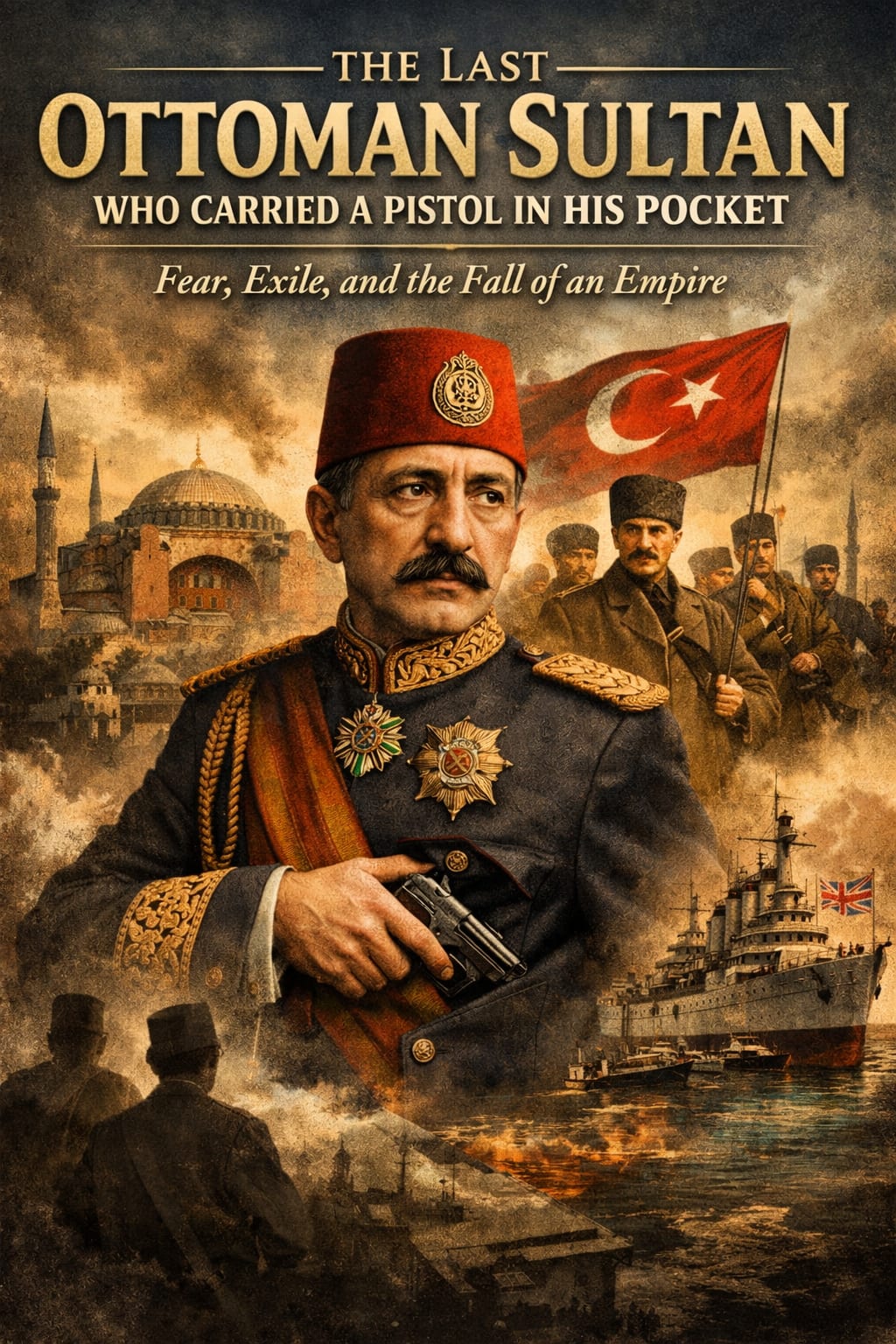
Fear, Exile, and the Fall of an Empire: The Final Days of Mehmed VI
---
The fall of the Ottoman Empire marked the end of one of history’s most powerful and enduring dynasties. For more than six centuries, the House of Osman ruled vast territories stretching across Europe, Asia, and Africa. Yet, in its final chapter, the empire’s last ruler lived not in splendor, but in fear. Mehmed VI, the final Sultan of the Ottoman Empire, was a man surrounded by uncertainty, political chaos, and real threats to his life. According to accounts from the turbulent years following World War I, he carried a pistol in his pocket, fearing assassination at any moment.
When Mehmed VI ascended the throne in 1918, the empire was already collapsing. The First World War had devastated Ottoman lands, and the empire stood defeated alongside its Central Powers allies. Allied forces, including Britain and France, occupied key parts of the empire, including the capital, Istanbul. Political unrest spread rapidly. Nationalist movements were rising, and faith in the monarchy was fading fast.
The once-mighty empire was being dismantled piece by piece. The humiliating Treaty of Sèvres in 1920 proposed severe territorial losses, effectively partitioning Ottoman lands. For many Turks, this treaty was a betrayal. While Mehmed VI remained the symbolic ruler, real power was slipping away. In Anatolia, a nationalist resistance movement led by Mustafa Kemal Atatürk was gaining momentum. This movement rejected foreign occupation and opposed the Sultan’s perceived cooperation with the Allies.
The Sultan found himself isolated—politically, socially, and personally. Once revered as Caliph and ruler of millions, he was now seen by many as weak or complicit in the empire’s humiliation. Istanbul was under foreign control, and nationalist forces considered the Sultan’s government illegitimate. Assassination rumors circulated widely. In such a tense atmosphere, it is said that Mehmed VI carried a pistol in his pocket for self-defense, fearing that an angry revolutionary or political rival might attempt to kill him.
This fear was not unfounded. The early 1920s were marked by political violence and instability. Officials were targeted, alliances shifted quickly, and loyalty was uncertain. The Sultan’s palace, once a symbol of unshakable authority, became a place of anxiety. The bodyguards who once symbolized imperial grandeur now represented a desperate attempt at protection.
Meanwhile, Mustafa Kemal’s nationalist forces were winning the Turkish War of Independence. By 1922, their victory was undeniable. On November 1, 1922, the Grand National Assembly in Ankara formally abolished the Sultanate. Mehmed VI was no longer Sultan. The Ottoman Empire, founded in 1299, had officially come to an end.
For Mehmed VI, the situation had become dangerous beyond measure. Stripped of power and legitimacy, he feared not only imprisonment but execution. Memories of past Ottoman palace coups and dethronements were still fresh in the empire’s long history. Sultans before him had been deposed, exiled, and even killed. He understood that revolutionary times often demand dramatic endings.
On November 17, 1922, Mehmed VI secretly left Istanbul aboard a British warship, HMS Malaya. Seeking refuge under British protection, he sailed into exile, leaving behind the throne of his ancestors. It was a dramatic and symbolic departure—the last Ottoman Sultan escaping his own capital under foreign guard. Shortly after his departure, his cousin was appointed Caliph, but even that title would be abolished in 1924 by the newly declared Republic of Turkey.
Exile was not kind to the former ruler. Mehmed VI spent his remaining years in Italy, far removed from the grandeur of Topkapi Palace and the imperial ceremonies that once defined his life. He died in 1926 in San Remo, reportedly in financial difficulty. His burial took place in Damascus, as the new Turkish government did not permit his remains to be returned to Istanbul.
The image of the last Ottoman Sultan carrying a pistol in his pocket is deeply symbolic. It represents the collapse of absolute monarchy in the modern age. It reflects a ruler who, despite centuries of inherited authority, could not escape the sweeping forces of nationalism, reform, and revolution. His personal fear mirrored the empire’s broader insecurity.
Mehmed VI’s story is not merely about one man’s anxiety. It is about the end of an era. The Ottoman Empire had once stood as a dominant world power, shaping politics, culture, and religion across continents. Yet in its final days, its ruler walked cautiously through palace halls, aware that history was turning against him.
Today, the fall of the Ottoman Empire and the rise of modern Turkey remain pivotal moments in world history. The transformation led by Mustafa Kemal Atatürk reshaped the region and introduced sweeping reforms that still define Turkey today. But behind those sweeping political changes stands a haunting image: the last Sultan, uncertain of his fate, carrying a small pistol in his pocket—an emperor reduced to guarding his own life in the twilight of empire.
About the Creator
Irshad Abbasi
Ali ibn Abi Talib (RA) said 📚
“Knowledge is better than wealth, because knowledge protects you, while you have to protect wealth.
Keep reading
More stories from Irshad Abbasi and writers in History and other communities.
The Untold Story of Tata Group , Who built the Empire ?
If you live in India, at some point in your day you probably come across a product from the Tata Group of Companies. Look at the cars running on the roads — you’ll see Tata Motors. Look up at planes flying in the sky — you’ll think of Air India. And the iconic Taj Hotel, famous all over the world, is also owned by the Tata Group. From power to fashion, from tea to salt — the Tata Group has a presence everywhere.
By Imran Ali Shah4 days ago in History




Comments
There are no comments for this story
Be the first to respond and start the conversation.