
The Last Sigh of Al-Andalus: When the Keys to Paradise Were Lost
The Fall of Granada and the End of Eight Centuries of Islamic Rule in Iberia

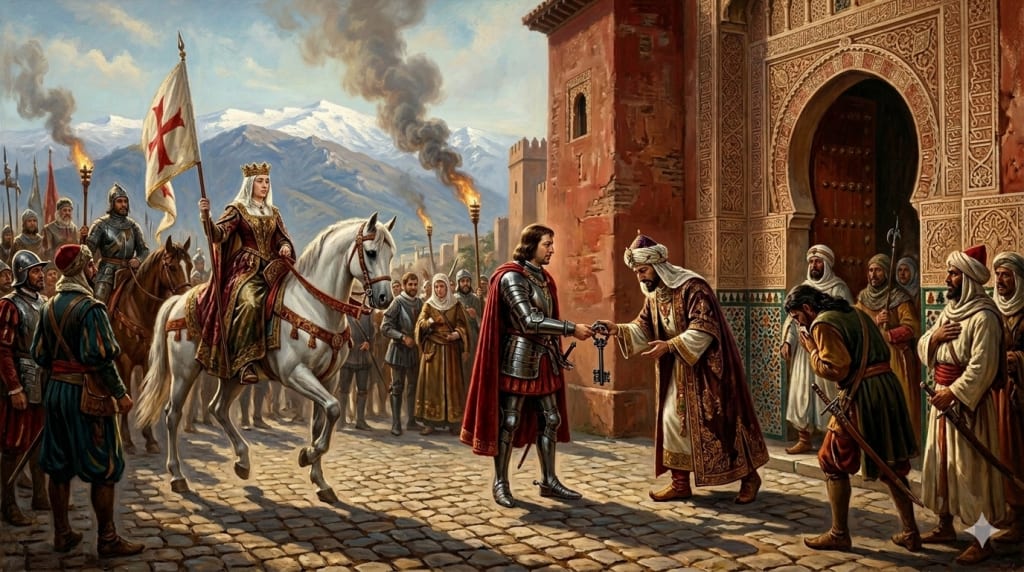
The date was January 2, 1492. As the morning mist cleared over the Sierra Nevada mountains, a somber procession wound its way down from the red walls of the Alhambra. At its head was Muhammad XII, known to the West as Boabdil, the last Sultan of the Nasrid dynasty. In his hands, he carried the keys to the city—keys that represented not just a fortress, but the final heartbeat of a civilization that had flourished for 781 years.
When he handed those keys to King Ferdinand and Queen Isabella, it marked the conclusion of the Reconquista and the definitive end of Al-Andalus.
The Jewel of the West
For centuries, Granada was more than a city; it was a sanctuary of intellect and beauty. While much of Europe was navigating the "Dark Ages," Granada was a beacon of the "Golden Age of Islam." It was a place where water flowed through intricate marble channels, where poets debated in jasmine-scented courtyards, and where the E = mc^2 of its era—the fusion of Greek philosophy, Eastern mathematics, and Western logic—was preserved and expanded.
The Alhambra itself stood as a testament to this refinement. Its delicate stucco work and geometric tiles were designed to reflect the Islamic concept of Paradise on Earth. To the Moors, losing Granada wasn't just a political defeat; it was the loss of a spiritual home.
The Internal Decay
The fall of Granada was not a sudden accident but the culmination of decades of internal strife. By the late 15th century, the Nasrid Kingdom was a "tributary state," paying massive amounts of gold to the Christian monarchs to maintain a fragile peace.
Internally, the court was fractured. Boabdil had famously seized the throne from his own father, leading to a bloody civil war that exhausted the city's resources. While the Muslims fought amongst themselves, Ferdinand and Isabella—the "Catholic Monarchs"—unified the crowns of Aragon and Castile, creating a superpower focused entirely on one goal: the total removal of Muslim power from the peninsula.
The Final Siege
The siege of Granada lasted for months. The city was isolated, its supply lines cut, and its population starving. Boabdil, realizing that further resistance would lead to the total massacre of his people and the destruction of the Alhambra, negotiated a treaty.
The Treaty of Granada was, on paper, surprisingly generous. It promised:
* Religious freedom for the Muslim population (Mudéjars).
* The preservation of Islamic law and customs.
* Protection of property and mosques.
However, these promises were short-lived. Within a decade, the policy of tolerance shifted to one of forced conversion, leading to the eventual expulsion of the Moriscos (converted Muslims) and the erasure of Islamic public life in Spain.
"The Moor's Last Sigh"
Legend tells us that as Boabdil rode away from the city, he stopped at a mountain pass to look back at the gleaming towers of the Alhambra one last time. He began to weep.
His mother, the formidable Aixa, allegedly rebuked him with words that have echoed through history:
> "Weep like a woman for what you could not defend as a man."
>
That spot is still known today as Puerto del Suspiro del Moro (The Pass of the Moor's Sigh). It marks the exact moment when the "Keys to Paradise" were officially handed over to a new era.
The Legacy of 1492
The fall of Granada changed the world far beyond the borders of Spain. In the same year Granada fell, Isabella funded Christopher Columbus’s voyage to the Americas. The wealth and crusading energy gathered from the conquest of Al-Andalus were redirected toward the New World, fueling the rise of the Spanish Empire.
For the Muslim world, the loss was a profound trauma, signaling a shift in the global balance of power. Yet, the architectural, linguistic, and scientific legacy of Muslim Spain remains woven into the very fabric of modern Europe. From the Spanish language to the irrigation systems of Andalusia, the "Paradise" Boabdil lost continues to live on in the heritage of the West.
About the Creator
Irshad Abbasi
Ali ibn Abi Talib (RA) said 📚
“Knowledge is better than wealth, because knowledge protects you, while you have to protect wealth.
Keep reading
More stories from Irshad Abbasi and writers in History and other communities.
“After Witnessing 40 Wars, Why Did 2025 Feel Like the Most Troubling Year Yet?”
For someone who has witnessed four decades of global conflict—wars in the Middle East, civil unrest in Africa, political revolutions in Europe, and prolonged military engagements in Asia—fear is not unfamiliar. History has been turbulent, and the world has endured devastating moments, from the Cold War era to modern terrorism. Yet, for many seasoned observers, 2025 felt uniquely unsettling. The question arises: why did this year, despite not hosting a single world war, feel more disturbing than the previous forty conflicts combined?
By Irshad Abbasi 2 days ago in History



Comments
There are no comments for this story
Be the first to respond and start the conversation.