
The Lost Coins of Alexander the Great: A Mysterious Discovery in Gaza
Ancient coins believed to be linked to the campaigns of Alexander the Great were once discovered in Gaza—only to mysteriously disappear, leaving historians searching for answers.

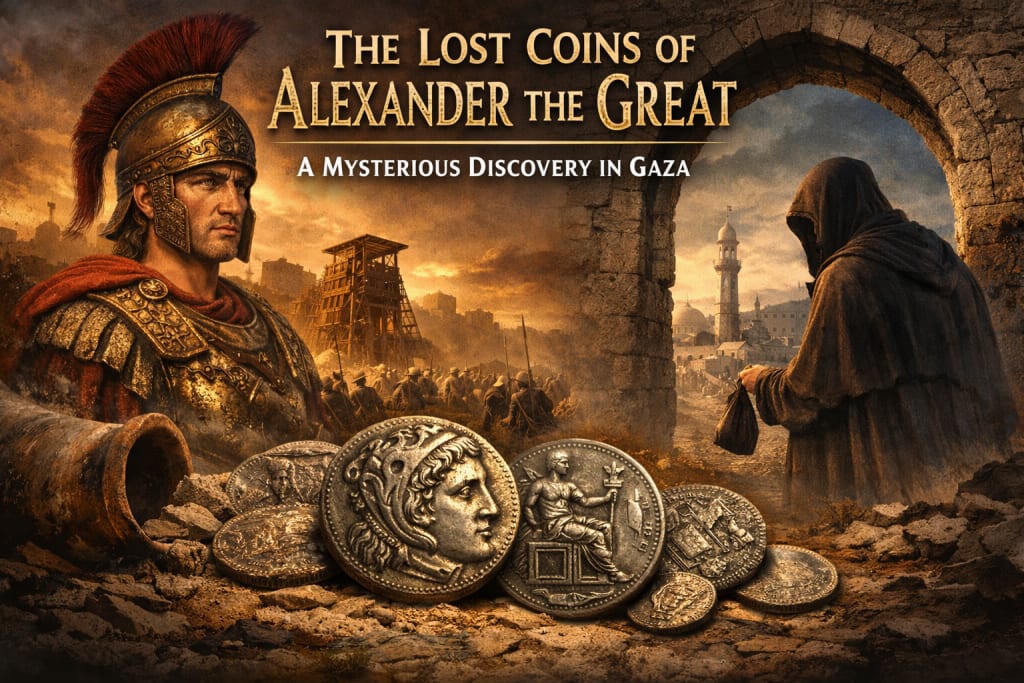
Few historical figures have captured the imagination of the world as powerfully as Alexander the Great. Known for building one of the largest empires in ancient history before the age of 32, Alexander’s campaigns stretched from Greece to Egypt and as far as India. Yet even today, more than two thousand years after his death, discoveries connected to his era continue to intrigue historians and archaeologists. One such mystery revolves around a remarkable discovery in the ancient city of Gaza—a hoard of coins believed to be linked to Alexander’s time, which later vanished under mysterious circumstances.
Alexander’s Campaign in Gaza
In 332 BCE, during his campaign against the Persian Empire, Alexander marched south toward Egypt. On his way, he encountered fierce resistance in Gaza, which was then a heavily fortified city under Persian control. The siege of Gaza became one of the most difficult battles of Alexander’s campaign.
After weeks of intense fighting and the construction of large siege ramps, Alexander’s army finally captured the city. Historical sources describe the battle as brutal, with heavy casualties on both sides. After taking Gaza, Alexander secured the strategic port city, ensuring his supply lines before moving on to Egypt, where he would later found the city of Alexandria.
The conquest of Gaza was not only a military victory but also an important moment for trade and administration in the region. As Alexander reorganized territories under his control, new coins were minted to symbolize political authority and facilitate commerce across his growing empire.
The Discovery of the Coins
Centuries later, archaeologists and local residents in Gaza reportedly uncovered a remarkable collection of ancient coins. Many experts believed these coins dated back to the era of Alexander the Great or the early Hellenistic period that followed his conquests.
The coins were made primarily of silver and bronze, featuring designs commonly associated with Alexander’s empire. Some displayed the image of the Greek hero Heracles wearing a lion’s skin, a symbol frequently used on coins issued during Alexander’s reign. Others featured Zeus seated on a throne holding an eagle—another well-known design used in Alexander’s coinage.
These coins were not only valuable in terms of precious metal but also historically significant. They offered a glimpse into the economic and political networks that spread across the Mediterranean and the Near East after Alexander’s conquests.
A Treasure That Disappeared
What made this discovery particularly mysterious was what happened next. Reports indicated that many of these coins disappeared shortly after they were found. Some may have been sold on the black market, while others were possibly lost during periods of political instability in the region.
Archaeological experts have long warned that conflict zones often become hotspots for the illegal trade of ancient artifacts. When important discoveries are not immediately secured and documented, valuable historical objects can vanish into private collections or underground markets.
In the case of the Gaza coins, historians believe that some pieces may still exist today, scattered across the world in museums or private holdings—though their exact origin might not always be clearly documented.
Why These Coins Matter
The missing coins from Gaza are more than just lost treasure. For historians, they represent pieces of evidence that could deepen our understanding of the Hellenistic world that emerged after Alexander’s conquests.
Coins from Alexander’s time were not only currency but also powerful tools of propaganda and identity. By placing Greek symbols, gods, and imagery on coins, Alexander helped spread a shared cultural and political message across his vast empire.
If the Gaza coins were fully studied, they might reveal valuable information about local governance, trade routes, and economic conditions in the region during the late fourth century BCE.
The Continuing Search
Despite the mystery surrounding their disappearance, historians and archaeologists remain hopeful that some of these coins may eventually resurface. In many cases, artifacts thought to be lost have reappeared decades later through museum donations, auctions, or archaeological investigations.
The story of the Gaza coins serves as a reminder of how fragile our connection to the past can be. Ancient objects carry stories that link us to civilizations long gone, and when they vanish, pieces of history disappear with them.
Yet the fascination with Alexander the Great continues to inspire new discoveries. Whether hidden underground or resting in forgotten collections, the lost coins of Gaza remain one of the many historical puzzles connected to one of history’s most legendary conquerors.
About the Creator
Irshad Abbasi
Ali ibn Abi Talib (RA) said 📚
“Knowledge is better than wealth, because knowledge protects you, while you have to protect wealth.
Keep reading
More stories from Irshad Abbasi and writers in History and other communities.
A Workshop from the Age of Alexander Discovered in Peshawar
Archaeologists in northwestern Pakistan have uncovered what appears to be an ancient workshop dating back to the era of Alexander the Great, offering new insights into the region’s historical importance during one of the most transformative periods in ancient history. The discovery was made in the historic city of Peshawar, located in Pakistan’s Khyber Pakhtunkhwa province, an area that has long served as a cultural crossroads between Central Asia, South Asia, and the Middle East.
By Irshad Abbasi a day ago in History


Comments
There are no comments for this story
Be the first to respond and start the conversation.