
Why Is the Modi Government Searching for the Tomb of Dara Shikoh?
The renewed effort to locate the grave of a Mughal prince reflects India’s complex relationship with history, heritage, and religious harmony.

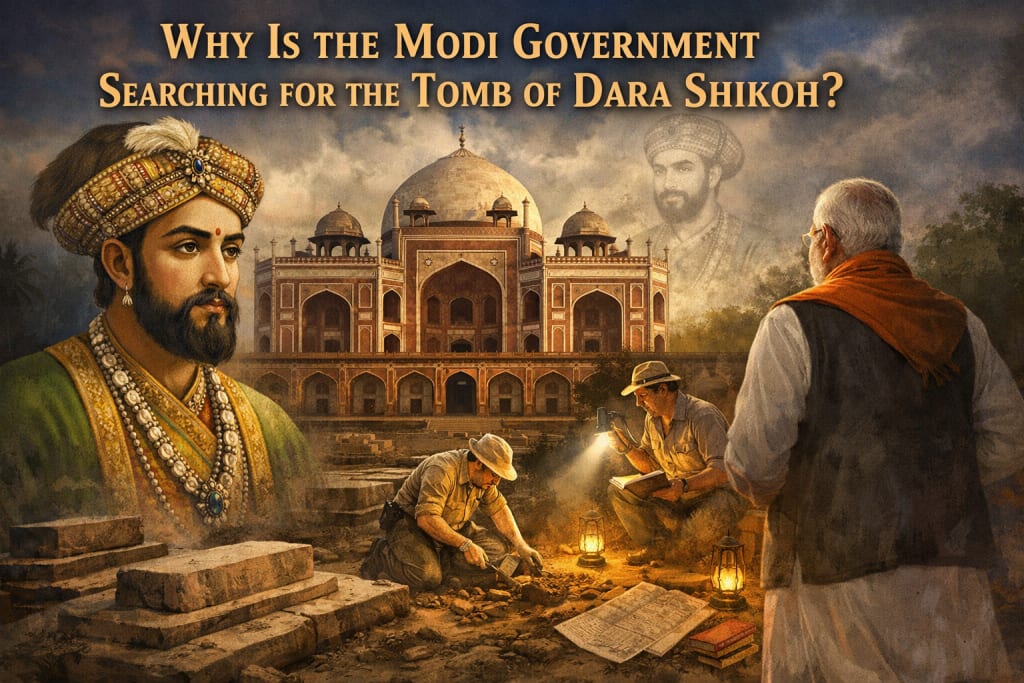
In recent years, discussions about the legacy of the Mughal Empire have become increasingly prominent in India. One intriguing development is the reported effort by the government led by Narendra Modi to locate the burial site of the Mughal prince Dara Shikoh. The search has sparked debate among historians, politicians, and the public alike. Many observers see it as part of a broader attempt to reinterpret India’s past and highlight figures who symbolize cultural harmony.
Who Was Dara Shikoh?
Dara Shikoh was the eldest son of the Mughal emperor Shah Jahan and the heir apparent to the Mughal throne in the mid-17th century. Born in 1615, he was known not only as a prince but also as a scholar, philosopher, and Sufi-minded thinker.
Unlike many political leaders of his time, Dara Shikoh developed a deep interest in spiritual dialogue between religions. He believed that different faith traditions contained shared spiritual truths. His most famous intellectual work was the Persian translation of the Upanishads, titled Sirr-e-Akbar (“The Great Secret”). By translating these Hindu philosophical texts, he attempted to bridge the gap between Islamic and Hindu spiritual traditions.
Because of this outlook, many modern historians consider Dara Shikoh a symbol of interfaith understanding and cultural openness in South Asian history.
The Struggle for the Mughal Throne
Dara Shikoh’s life took a tragic turn during the war of succession among the sons of Shah Jahan in the 1650s. His main rival was his younger brother Aurangzeb.
When Shah Jahan fell ill in 1657, a fierce power struggle began. Although Dara Shikoh was the designated successor and enjoyed his father’s support, Aurangzeb proved to be the stronger military strategist. After a series of battles, Aurangzeb defeated Dara’s forces in 1658.
Dara Shikoh attempted to flee and regroup, but he was eventually captured in 1659. Soon afterward, Aurangzeb ordered his execution. According to historical accounts, Dara was buried quietly and without ceremony, likely somewhere in the Mughal burial grounds near Humayun’s Tomb in Delhi.
However, the exact location of his grave was never clearly recorded, and over the centuries it faded into uncertainty.
Why Is His Tomb Being Searched For Now?
The renewed interest in locating Dara Shikoh’s grave emerged from academic and archaeological discussions in India. Researchers have suggested that his burial site may lie among several unmarked graves inside the complex of Humayun’s Tomb, a UNESCO World Heritage Site.
In recent years, the Archaeological Survey of India has examined historical documents and burial records in an effort to identify the grave more precisely.
Supporters of the search argue that finding Dara Shikoh’s tomb would restore recognition to a historical figure who represents tolerance and intellectual exchange. In a time when debates about religion and identity are often heated, some scholars believe that highlighting Dara’s legacy could serve as a reminder of India’s long tradition of cultural diversity.
Political and Historical Debate
The search has also sparked political debate. Critics argue that the interest in Dara Shikoh may reflect modern political messaging rather than purely historical curiosity. Some observers believe the government wishes to emphasize Mughal figures who promoted religious dialogue rather than those associated with stricter rule.
In contrast, supporters say that rediscovering Dara’s grave is simply part of preserving India’s historical heritage. They argue that many Mughal monuments and burial sites remain poorly documented, and archaeological research can help clarify important chapters of the subcontinent’s past.
Historians also note that Dara Shikoh’s intellectual contributions are increasingly appreciated today. His attempt to connect Islamic Sufi ideas with Hindu philosophy was centuries ahead of its time and continues to influence discussions about interfaith understanding.
A Symbol Beyond Politics
Regardless of political interpretations, Dara Shikoh’s life story carries a powerful symbolic meaning. He represents a vision of South Asia where religious traditions could learn from one another rather than compete for dominance.
If his tomb is eventually identified, it may become an important historical site, reminding visitors of a Mughal prince who chose scholarship and spiritual dialogue over power politics.
More than three centuries after his death, the search for Dara Shikoh’s grave is therefore not just about archaeology. It is also about how modern societies remember the past and which historical figures they choose to honor.
In that sense, the renewed interest in Dara Shikoh reflects an ongoing conversation about identity, tolerance, and the many layers of South Asian history.
About the Creator
Irshad Abbasi
Ali ibn Abi Talib (RA) said 📚
“Knowledge is better than wealth, because knowledge protects you, while you have to protect wealth.
Keep reading
More stories from Irshad Abbasi and writers in History and other communities.
From Repeated Defeats to the Founder of the Mughal Empire
In the early sixteenth century, the political landscape of Central and South Asia was shaped by ambition, warfare, and shifting alliances. Among the many princes struggling for power during this period was Zahir‑ud‑Din Muhammad Babur, a young Timurid ruler whose life was defined by repeated setbacks. Ironically, it was these failures that ultimately pushed him toward the Indian subcontinent, where he would establish the Mughal Empire, one of the most influential empires in world history.
By Irshad Abbasi 2 days ago in History




Comments
There are no comments for this story
Be the first to respond and start the conversation.