
Why America Attacked Iran
Unraveling the Motivations Behind a New Middle East War

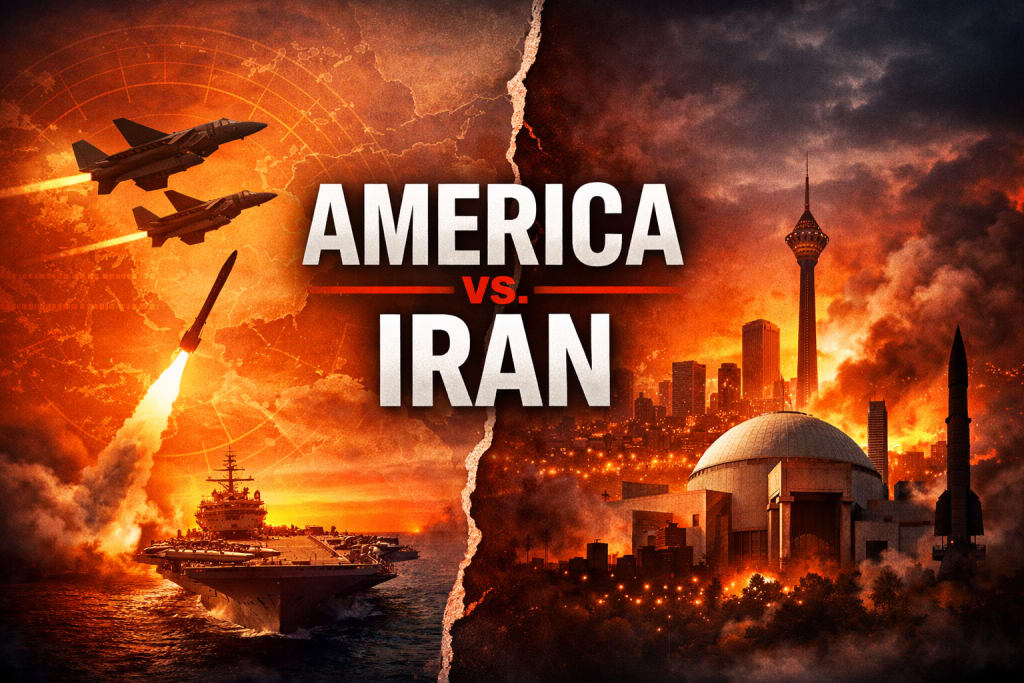
“America Just Struck Iran — And the World Is Holding Its Breath”
The United States and Israel are now engaged in direct military action against the Islamic Republic of Iran — a dramatic escalation that marks one of the most consequential shifts in American foreign policy in decades. The conflict, which erupted at the end of February 2026, has already reshaped geopolitics in the Middle East and sparked widespread debate over Washington’s objectives and justifications.
The Spark: Rising Tensions and Military Buildup
In the months leading up to the offensive, U.S.–Iran tensions intensified sharply. The Trump administration escalated Washington’s military presence across the Middle East, deploying aircraft carriers, fighter squadrons, missile defenses, and additional troops — the largest U.S. buildup in the region since 2003. This deployment was officially framed as deterrence against what Washington described as escalating threats from Tehran’s nuclear program, ballistic missiles, and support for militant groups throughout the region.
Diplomatic efforts to resolve these tensions collapsed. In talks held in Geneva, American negotiators sought to curb Iran’s uranium enrichment activities, but the discussions broke down amid mutual distrust. Iranian leaders insisted their nuclear program was peaceful — a claim disputed by U.S. officials and intelligence assessments.
Administration Justifications for War
When the United States launched its military operation — dubbed Operation Epic Fury — President Donald Trump outlined several reasons for the attack:
Perceived imminent threat: Trump asserted that Iran was poised to strike U.S. forces or allies, claiming that a pre‑emptive strike was necessary to prevent Iran from acting first — even though the administration offered no publicly verifiable intelligence to support this claim.
Missile and nuclear concerns: U.S. officials pointed to Iran’s growing arsenal of ballistic missiles and possible future nuclear capabilities as existential threats to American interests and regional stability. Although past U.S. assessments suggested Tehran was not close to building nuclear weapons, the administration cited these programs to justify military action.
Regional influence and proxies: Washington has long criticized Iran’s support for non‑state armed groups such as Hezbollah in Lebanon and the Houthis in Yemen — networks that have targeted U.S. allies and bases over the years.
Internal repression and regime change: Trump and senior officials occasionally framed the offensive as an opportunity to weaken an oppressive regime, implicitly suggesting that removing Iran’s leadership would benefit its people — a rationale that echoes past U.S. interventions.
Critics and Contradictions
The administration’s justifications have been inconsistent and widely contested. Republican and Democratic lawmakers alike have questioned the claim of an imminent threat, noting a lack of evidence that Iran was about to attack U.S. territory. Some senior figures even suggested that Israeli plans to strike Tehran had influenced U.S. timing — a notion the White House publicly denied.
Legal scholars and civil liberties advocates have also raised alarm about the lack of congressional authorization for a major war, arguing that the executive branch overstepped constitutional limits. Public opinion in the United States reflected deep skepticism, with polls showing significant disapproval of the conflict’s rationale.
The Human and Geopolitical Cost
Since the offensive began, U.S. and Israeli forces have conducted thousands of airstrikes against Iranian military infrastructure. Iran has responded with missile and drone attacks on U.S. bases and allied nations in the Gulf. Casualties have mounted on both sides, and the conflict threatens to expand beyond Iran’s borders as regional actors are drawn into the fighting.
At the United Nations, Secretary‑General António Guterres condemned both sides and urged a return to diplomacy, warning that unchecked escalation could trigger broader instability. China, Russia, and several Arab states called for restraint and a negotiated settlement.
Beyond the Headlines
The Iran war has its roots not only in immediate military clashes but in decades of strategic distrust between Tehran and Washington. Past U.S. interventions, historical grievances dating back to the 1979 Iranian Revolution, and simmering disputes over regional influence have created an environment where accusations of aggression and insecurity feed one another.
Critics argue that labeling Iran’s nuclear ambitions as an existential threat lacks nuance and overlooks the possibility of diplomatic solutions. Supporters of the war point to Iran’s missile programs and its network of regional proxies as ongoing dangers that justify robust action. What remains clear is that, for now, neither side shows willingness to step back without achieving its core objectives.
About the Creator
Zakir Ullah
I am so glad that you are here.
Keep reading
More stories from Zakir Ullah and writers in Journal and other communities.
TikTok USA Account: How I Started and Learned to Earn from Short Videos
When I first downloaded TikTok, it was just for fun. I spent hours scrolling through endless videos—dances, jokes, tutorials, and stories from people all over the world. I never thought about posting myself, let alone earning money from it.
By Zakir Ullah6 months ago in Journal



Comments
There are no comments for this story
Be the first to respond and start the conversation.