
Qatar Shoots Down Two Iranian Su-24 Fighter Jets Over Airspace as Gulf States Suffer Iran Strikes
A dramatic escalation in Gulf skies signals how quickly the regional conflict is widening
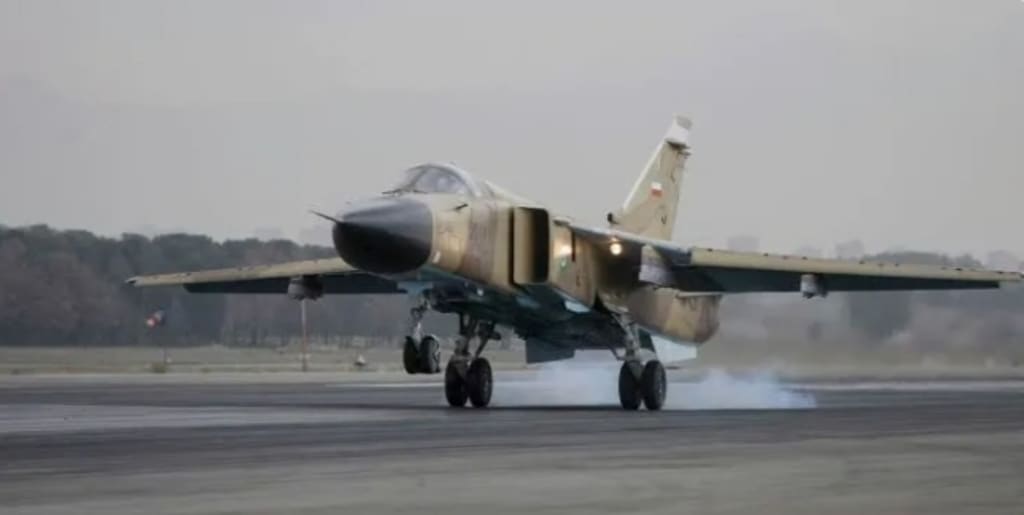
The skies over the Gulf have become a battlefield.
In a stunning development, Qatar announced that it had shot down two Iranian Su-24 fighter jets after they allegedly entered Qatari airspace during a wave of missile and drone attacks. The incident marks one of the most direct military confrontations between a Gulf state and Iran in recent years — and it underscores how rapidly the region’s simmering tensions are transforming into open confrontation.
While missile interceptions have become more common in recent weeks, the destruction of manned combat aircraft takes the escalation to another level entirely.
What Happened?
According to Qatari defense officials, the two Iranian Sukhoi Su-24 jets were detected approaching or entering Qatari airspace amid a broader barrage of missiles and drones launched toward Gulf targets. Qatari air-defense systems responded swiftly, intercepting multiple incoming projectiles and engaging the aircraft before they could penetrate deeper into national territory.
Doha described the operation as a necessary act of self-defense.
The timing is significant. The shoot-down occurred during a surge in Iranian strikes across Gulf states, widely seen as retaliation for recent military actions against Iranian assets elsewhere in the region. Several Gulf countries have reported intercepting ballistic missiles and drones over their territory in recent days.
In this increasingly volatile environment, Qatar’s response signals that Gulf states are prepared not only to defend against missiles — but to directly confront hostile aircraft.
Why the Su-24 Matters
The Su-24 is a Soviet-era tactical bomber designed for low-altitude penetration and ground attack missions. While not among the most modern jets in Iran’s arsenal, it remains capable of delivering precision strikes and operating in contested environments.
Its appearance in Gulf airspace — if confirmed — suggests a deliberate escalation beyond remote missile launches. The use of manned aircraft introduces a different level of risk and symbolism.
Missiles can be launched from afar. Jets crossing borders represent visible, immediate confrontation.
For Qatar, allowing such aircraft to operate unchallenged would undermine sovereignty and deterrence. For Iran, losing two aircraft represents both a tactical setback and a political statement.
A Region on Edge
This incident does not stand alone.
In recent days:
Gulf airspaces have temporarily closed.
Commercial flights have been diverted or canceled.
Missile defense systems across the region have remained on high alert.
Energy markets have reacted nervously to rising instability.
The Gulf Cooperation Council (GCC) states have reportedly intensified consultations, emphasizing regional unity and collective security. What was once a localized conflict dynamic is increasingly pulling in multiple actors.
The Gulf is not merely adjacent to the crisis — it is becoming a central theater.
The Strategic Implications
The downing of Iranian jets changes the equation in several ways.
1. Direct State-to-State Engagement
This is not a proxy skirmish. It is a sovereign state shooting down another state’s military aircraft. That alone raises the stakes dramatically.
2. Escalation Risks Multiply
When manned aircraft are destroyed, questions follow: Were pilots captured? Were there casualties? Will there be retaliation? Each answer can trigger another move.
3. Deterrence Messaging
Qatar’s action sends a signal to Tehran: violations of airspace will not be tolerated. But it also signals to regional partners — including the United States — that Gulf states are willing to act decisively in defense of their territory.
The Broader Conflict Context
Iran’s recent strikes across the Gulf appear to be part of a wider retaliatory campaign linked to escalating hostilities elsewhere in the Middle East. Gulf nations hosting Western military assets have become indirect participants in a broader confrontation.
Qatar, while maintaining diplomatic channels with a range of actors, is home to significant strategic infrastructure. That makes it both a partner and a potential target in times of crisis.
The involvement of air power suggests that the conflict may no longer be confined to long-range missile exchanges. It is entering a phase where air superiority, rapid interception, and real-time engagement play critical roles.
Civilian and Economic Fallout
The immediate military drama is only part of the story.
The Gulf region is one of the world’s busiest aviation hubs. Temporary airspace closures have disrupted global travel routes linking Europe, Asia, and Africa. Airlines are recalculating flight paths. Insurance premiums are climbing.
Energy markets, always sensitive to Gulf instability, have reacted with caution. Investors know that sustained military activity near key infrastructure can ripple across global supply chains.
In an interconnected world, instability in Gulf skies doesn’t stay in Gulf skies.
What Happens Next?
The critical question now is whether this incident becomes:
A contained episode of defensive engagement, or
The opening chapter of a wider regional air war.
Iran may choose to recalibrate, relying more heavily on missiles and drones. Or it could respond forcefully to reassert deterrence. Gulf states, meanwhile, are unlikely to lower their guard.
Diplomatic channels may intensify behind the scenes. Public rhetoric, however, may remain sharp as each side seeks to project strength.
A Defining Moment in Gulf Security
For years, analysts warned that Gulf security was becoming more fragile, with missile proliferation and drone warfare lowering the threshold for conflict.
Now that fragility is on display.
Qatar’s downing of two Iranian Su-24 jets is not just a military event — it is a symbol of how quickly regional tensions can spill into open confrontation. It underscores that the Gulf is no longer merely a buffer zone in broader rivalries.
It is a frontline.
Whether this moment leads to deterrence or deeper escalation depends on decisions made in the coming days. But one thing is certain: the balance of power in the Gulf’s skies just shifted — and the entire region is watching closely.
About the Creator
A Gathering of Evil Bosses
“I’m the queen of chin jutting while I smooth my hair, attacking, insulting, and deflecting to protect my appointer.” “Oh, please, Blondi, my hair is curled, highlighted, and longer than yours. I feature television commercials telling immigrants that we will give them a free plane ride home, and if they voluntarily turn themselves in, they will be allowed to legally apply for re-entry. It runs everywhere, and I look good in it! You can’t compete because of your blond hair. Mine is nicer, and my lips are prettier than yours.”
By Andrea Corwin 12 days ago in The Swamp
Pearl
1980 something. we all hung out at Pearl and you and i were nothing special, or so i thought. i mean we all danced, drenched in our own sweat, our own saline solution of fear, too many beers, shots, laughter, tears, fucks in the bathroom and i don't know when we began to be afraid. do you?
By ROCK aka Andrea Polla (Simmons)5 days ago in Fiction




Comments
There are no comments for this story
Be the first to respond and start the conversation.