
The Nazi Who Fooled Death
How Albert Speer traded "guilt" for his life.

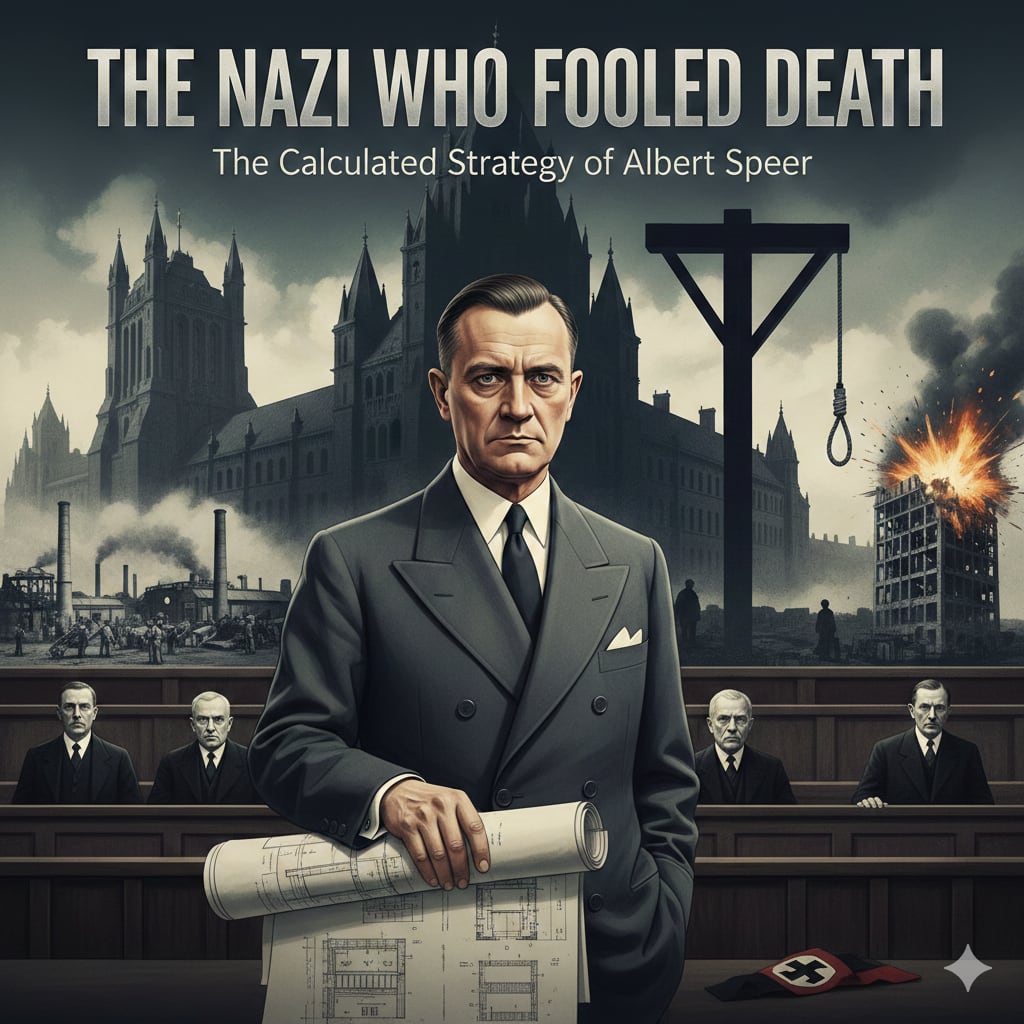
History often remembers the Nuremberg Trials as the ultimate reckoning for the Third Reich—a moment where the high command of Nazi Germany faced the gallows for their part in the 20th century's greatest horrors. Men like Joachim von Ribbentrop and Wilhelm Keitel met their end at the end of a rope. Yet, one man from Hitler’s innermost circle, his "best friend" and Minister of Armaments, Albert Speer, managed to walk away from the courtroom with his life.
Speer’s survival was not a stroke of luck; it was the result of a brilliant, cold, and deeply calculated psychological strategy that separated him from his fanatical peers.
The Architect of Total War
Before the trials, Albert Speer was perhaps the most influential man in Germany after Hitler. As an architect, he gave the Nazi regime its grand aesthetic; as the Minister of Armaments, he kept the German war machine running long after it should have collapsed. He was the "Technocrat of Death," utilizing millions of slave laborers to fuel the production of tanks and planes.
When he stood in the dock at Nuremberg in 1945, the evidence against him was overwhelming. By all legal standards of the time, he was a prime candidate for execution. However, Speer realized early on that a defiant defense—the kind used by Hermann Göring—would only lead to the noose.
The "Good Nazi" Strategy
Speer’s strategy for survival rested on three distinct pillars: collective responsibility, technocratic distance, and the "Apology."
1. The Admission of Collective Guilt
While other defendants argued they were "just following orders" or denied that atrocities occurred, Speer took a radical path. He admitted that the Nazi regime had committed unspeakable crimes and stated that, as a top minister, he shared collective responsibility for them.
This was a masterstroke. By admitting a general, "abstract" guilt, he appeared more honest and moral than the other defendants. It charmed the judges, who saw him as a "gentleman" among thugs. Crucially, while he admitted to general guilt, he remained remarkably elusive about his knowledge of specific crimes, such as the Holocaust.
2. The Technocrat’s Shield
Speer portrayed himself not as a politician or a racial ideologue, but as a pure technocrat. He argued that he was an architect and an engineer who was simply "seduced" by Hitler’s vision. He claimed his only interest was efficiency and production, subtly distancing himself from the "dirty" work of the SS and the Gestapo.
He painted a picture of a man who lived in a world of blueprints and statistics, unaware of the reality of the concentration camps—despite the fact that many of his factories were located within those very camps.
3. The Myth of the Assassination Plot
To cement his image as a "reformed" Nazi, Speer dropped a bombshell during the trial: he claimed that in the final days of the war, he had plotted to assassinate Hitler by piping poison gas into the Führerbunker.
While historians have since found little evidence that this plot was ever more than a vague thought, it served its purpose in 1946. It convinced the tribunal that Speer had turned against the regime from within, making him a "repentant" figure rather than a loyalist.
The Verdict: Life Over Death
The strategy worked. While the court found him guilty of war crimes and crimes against humanity, the "Speer Myth" created enough doubt and sympathy to spare his life. While Göring and others were sentenced to death, Speer was sentenced to 20 years in Spandau Prison.
The Legacy of a Lie
After his release in 1966, Speer became a best-selling author and a media sensation, further refining his image as the "Good Nazi." He spent the rest of his life maintaining that he "didn't know" about the Final Solution.
However, decades later, letters and documents emerged proving that Speer was present at the Posen Conference in 1943, where the extermination of the Jews was explicitly discussed. The "Strategy" that saved his life was, in reality, a carefully constructed facade.
Conclusion
Albert Speer did not escape the noose because he was innocent; he escaped because he understood the psychology of his captors. He gave the judges the "repentant Nazi" they desperately wanted to see. In doing so, he became the ultimate architect—designing a narrative that allowed him to live while his colleagues swung from the gallows.
About the Creator
Irshad Abbasi
Ali ibn Abi Talib (RA) said 📚
“Knowledge is better than wealth, because knowledge protects you, while you have to protect wealth.
Keep reading
More stories from Irshad Abbasi and writers in History and other communities.
Modernizing India through Rails, Canals, and Conquest
History often remembers the British Raj through the lens of conflict and colonization, but few figures embody the complex duality of "modernizer" and "conqueror" as starkly as James Broun-Ramsay, the 1st Marquess of Dalhousie. Appointed as the Governor-General of India in 1848 at the remarkably young age of 35, Dalhousie commanded a staggering annual salary of £25,000—a fortune at the time. His eight-year tenure would fundamentally alter the physical and political geography of the Indian subcontinent.
By Irshad Abbasi a day ago in History
The Radical Life and Stoic Death of W.T. Stead
W.T. Stead was the first person to understand that the media could be used as a weapon, a concept that now dominates all aspects of our lives. He frequently used the platform he had built to attack political and social causes to great effect.
By Sam H Arnold7 days ago in History



Comments
There are no comments for this story
Be the first to respond and start the conversation.