Irshad Abbasi
Bio
Ali ibn Abi Talib (RA) said 📚
“Knowledge is better than wealth, because knowledge protects you, while you have to protect wealth.
Stories (407)
Filter by community
The World’s Strangest Border: Where One Country Lives Inside Another
Borders usually appear simple on maps—clear lines separating one nation from another. Yet in some places, the reality is far more complicated. For many years, the border between India and Bangladesh was considered one of the strangest and most confusing borders in the world. It contained dozens of tiny pieces of land belonging to one country but completely surrounded by the other, creating a geographical puzzle that fascinated historians, geographers, and travelers alike.
By Irshad Abbasi 4 days ago in Wander
Black Liberty on a Commemorative Coin: Redefining America’s Symbol of Freedom
In recent years, the United States has taken symbolic steps to reflect the diversity of its people in national imagery. One of the most notable examples came when the U.S. Mint introduced a commemorative coin depicting Liberty as a Black woman. For more than two centuries, Liberty—the personification of freedom in American iconography—had traditionally been portrayed as a white woman of classical European appearance. The introduction of a Black Liberty marked a significant shift in how the nation represents its ideals.
By Irshad Abbasi 4 days ago in History
Circumcision in Ancient Egypt: Ritual, Identity, and Medical Practice
Circumcision, the surgical removal of the foreskin from the male genitalia, is a practice that dates back thousands of years. Among the earliest civilizations known to have practiced circumcision were the ancient Egyptians. Evidence from archaeological discoveries, wall carvings, and historical writings suggests that circumcision was not merely a medical procedure in Ancient Egypt but a practice deeply embedded in religious beliefs, social identity, and cultural traditions.
By Irshad Abbasi 4 days ago in History
Discovery of a Massive Void Inside Khufu’s Pyramid Stuns Archaeologists
The ancient world continues to reveal its secrets, and one of the most remarkable discoveries in recent years has emerged from the heart of Egypt’s most famous monument—the Great Pyramid of Giza. Scientists and archaeologists have confirmed the presence of a large previously unknown void inside the pyramid of Pharaoh Khufu, sparking global excitement and renewed curiosity about how and why this monumental structure was built more than 4,500 years ago.
By Irshad Abbasi 4 days ago in History
Ancient Roman Secrets: What Their Monuments Teach Us About Sustainable Construction
Across Europe and the Mediterranean, the remains of ancient Roman structures continue to amaze architects, engineers, and historians alike. Massive aqueducts still stretch across valleys, amphitheaters remain standing after centuries of earthquakes and wars, and the iconic Pantheon in Rome still boasts the world’s largest unreinforced concrete dome. These remarkable structures are more than just archaeological treasures; they hold important lessons for modern construction. Hidden within these monuments is a set of engineering secrets that could help today’s builders create stronger, longer-lasting, and more sustainable structures.
By Irshad Abbasi 4 days ago in History
Living on Just a Few Spoonfuls a Day: The Woman Who Still Traveled to 28 Countries
For most people, traveling the world requires energy, stamina, and the ability to keep up with the physical demands of long journeys. But for one remarkable woman, even eating a normal meal is impossible. She can consume only three to four spoonfuls of food in an entire day. Yet despite this severe limitation, she has managed to travel to 28 countries, inspiring thousands with her determination and courage.
By Irshad Abbasi 5 days ago in Cleats
Three Pakistani Women Explore Egypt in Wheelchairs, Challenging Stereotypes
Traveling across a foreign country can be challenging for anyone, but for three Pakistani women who use wheelchairs, it became a powerful statement of courage, independence, and resilience. Their journey to Egypt was not just a vacation—it was a mission to challenge social perceptions and inspire others living with disabilities.
By Irshad Abbasi 5 days ago in History
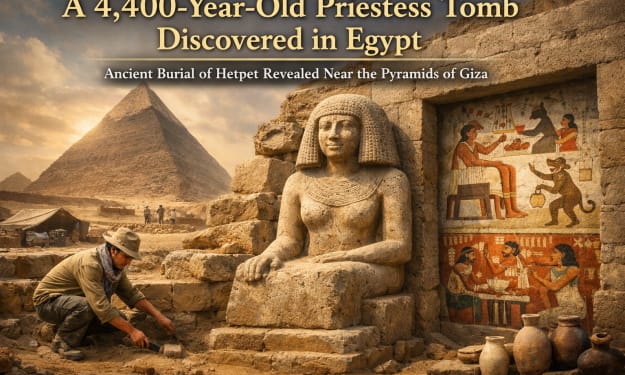
A 4,400-Year-Old Priestess Tomb Discovered in Egypt
Archaeologists in Egypt have uncovered the remarkable tomb of a priestess that dates back approximately 4,400 years, offering new insight into religion, culture, and daily life during the height of the ancient Egyptian civilization. The discovery was made near the famous pyramids on the Giza Plateau, one of the most important archaeological areas in the world. Experts believe the tomb belonged to a high-ranking priestess named Hetpet, who lived during Egypt’s Fifth Dynasty, around 2400 BC. 
By Irshad Abbasi 5 days ago in History
A 2,000-Year-Old Sphinx Statue Discovered in Egypt
Archaeologists in Egypt have uncovered an extraordinary ancient statue shaped like a sphinx that dates back roughly 2,000 years, providing historians with fresh insight into Egypt’s long and complex past. The discovery was announced by Egypt’s Ministry of Tourism and Antiquities after an archaeological mission unearthed the statue during excavation work near the Temple of Hathor in Dendera, located in Qena Province in southern Egypt.
By Irshad Abbasi 5 days ago in History
The Destruction of Palmyra’s Roman Amphitheater and Tetrapylon by ISIS
In the heart of the Syrian desert lies the ancient city of Palmyra, one of the most remarkable archaeological treasures of the ancient world. For centuries, this historic oasis city stood as a meeting point of civilizations, where Roman, Persian, Greek, and local cultures blended together. Among its most iconic monuments were the magnificent Roman Amphitheater of Palmyra and the elegant Tetrapylon of Palmyra. Sadly, both structures suffered devastating destruction during the Syrian civil war when the militant group Islamic State of Iraq and Syria (ISIS) seized control of the city.
By Irshad Abbasi 5 days ago in History
Aristotle and Alexander: How a Philosopher’s Lessons Helped Shape World History
History often remembers kings, conquerors, and great battles. Yet behind many powerful rulers stand teachers whose ideas quietly shape the future. One of the most famous examples of this relationship is the connection between Aristotle, one of the greatest philosophers in history, and his student Alexander the Great, the young Macedonian king who built one of the largest empires the world had ever seen.
By Irshad Abbasi 5 days ago in History
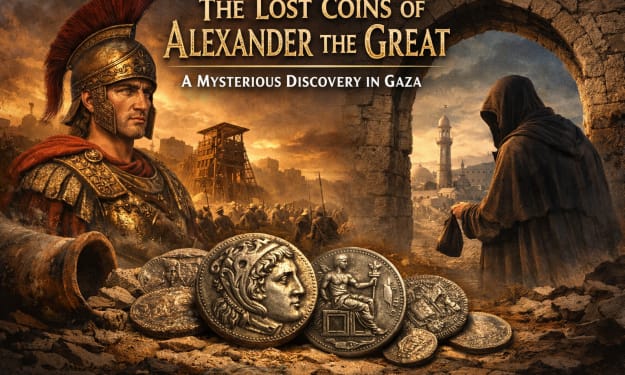
The Lost Coins of Alexander the Great: A Mysterious Discovery in Gaza
Few historical figures have captured the imagination of the world as powerfully as Alexander the Great. Known for building one of the largest empires in ancient history before the age of 32, Alexander’s campaigns stretched from Greece to Egypt and as far as India. Yet even today, more than two thousand years after his death, discoveries connected to his era continue to intrigue historians and archaeologists. One such mystery revolves around a remarkable discovery in the ancient city of Gaza—a hoard of coins believed to be linked to Alexander’s time, which later vanished under mysterious circumstances.
By Irshad Abbasi 5 days ago in History